The schematics.
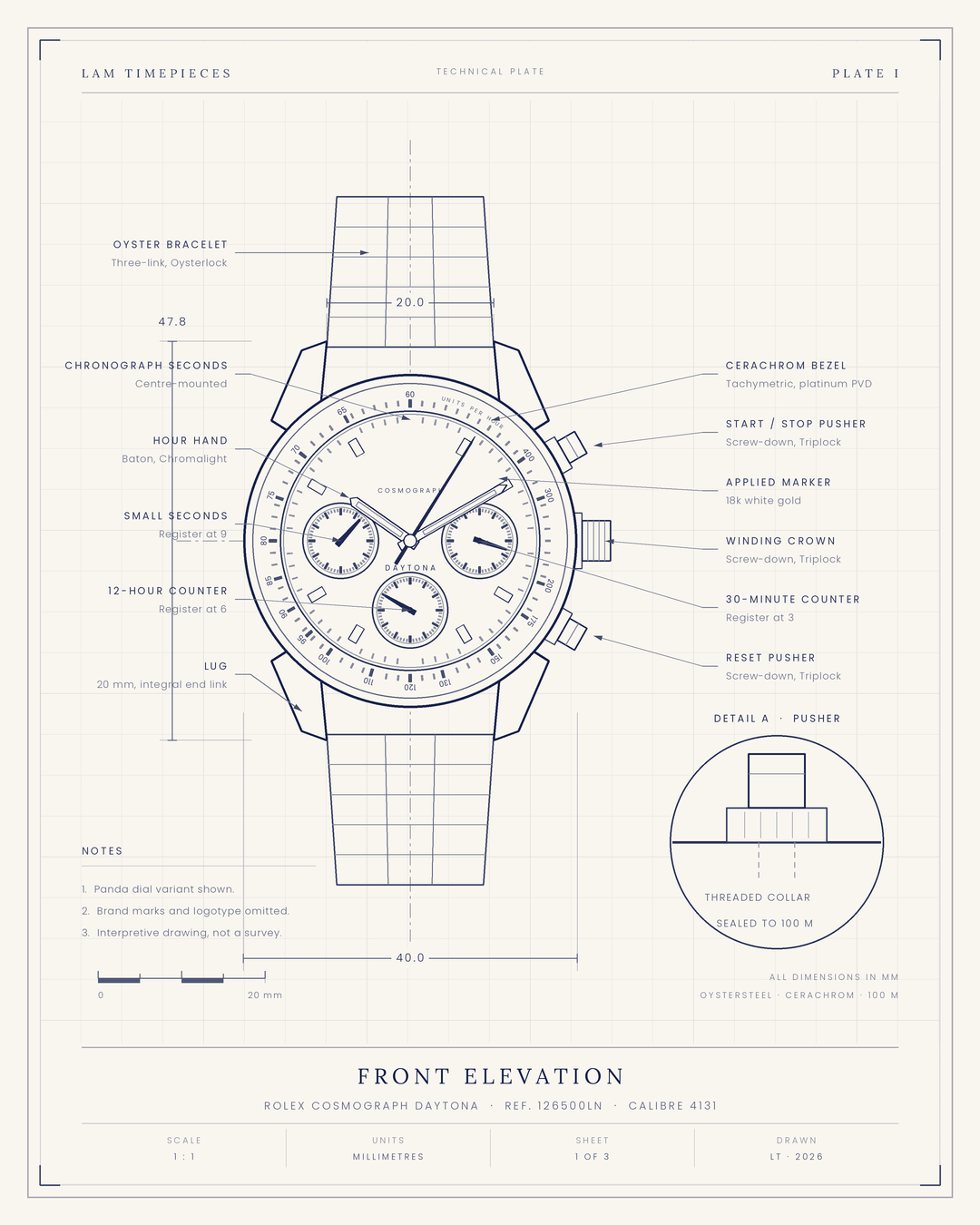
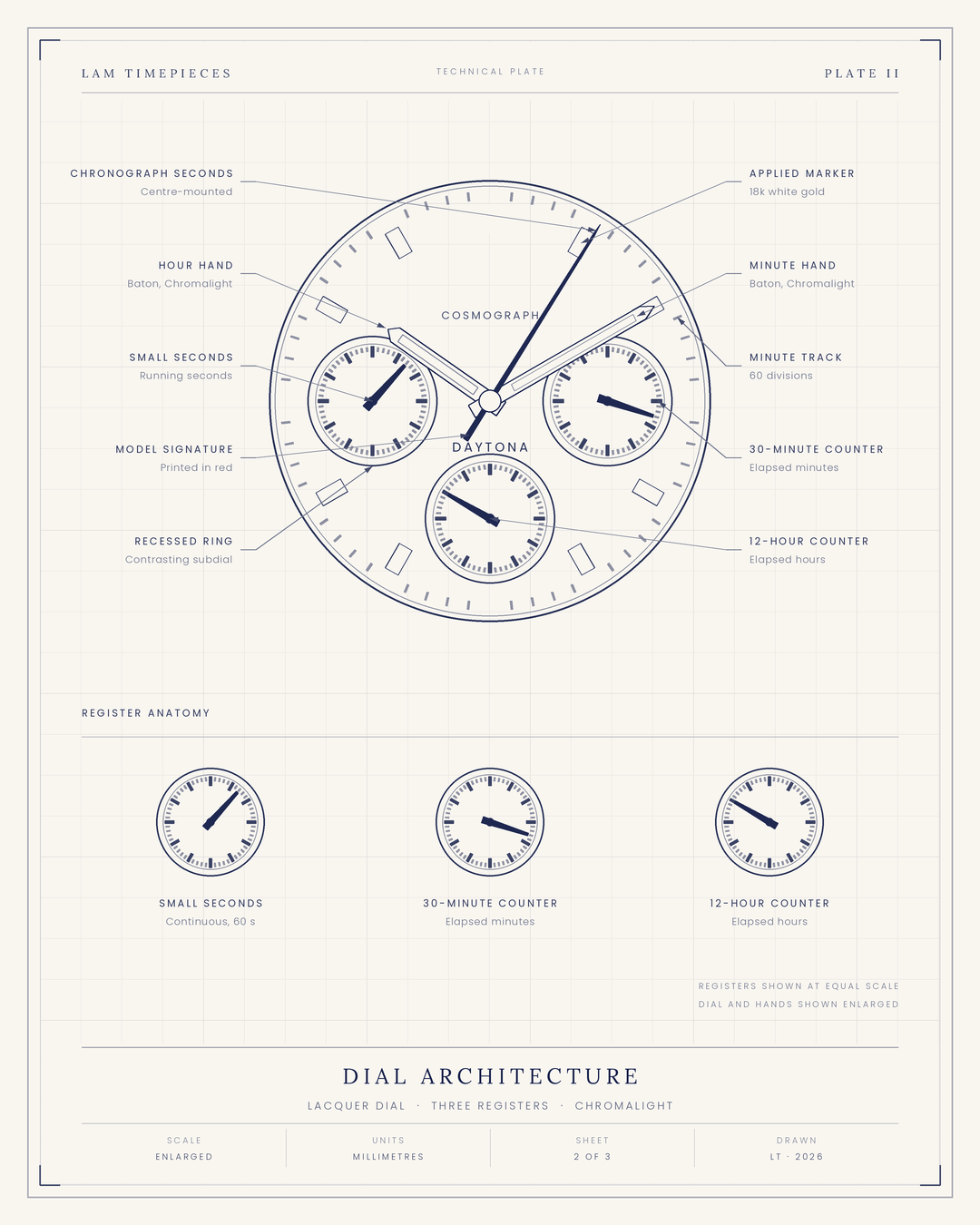
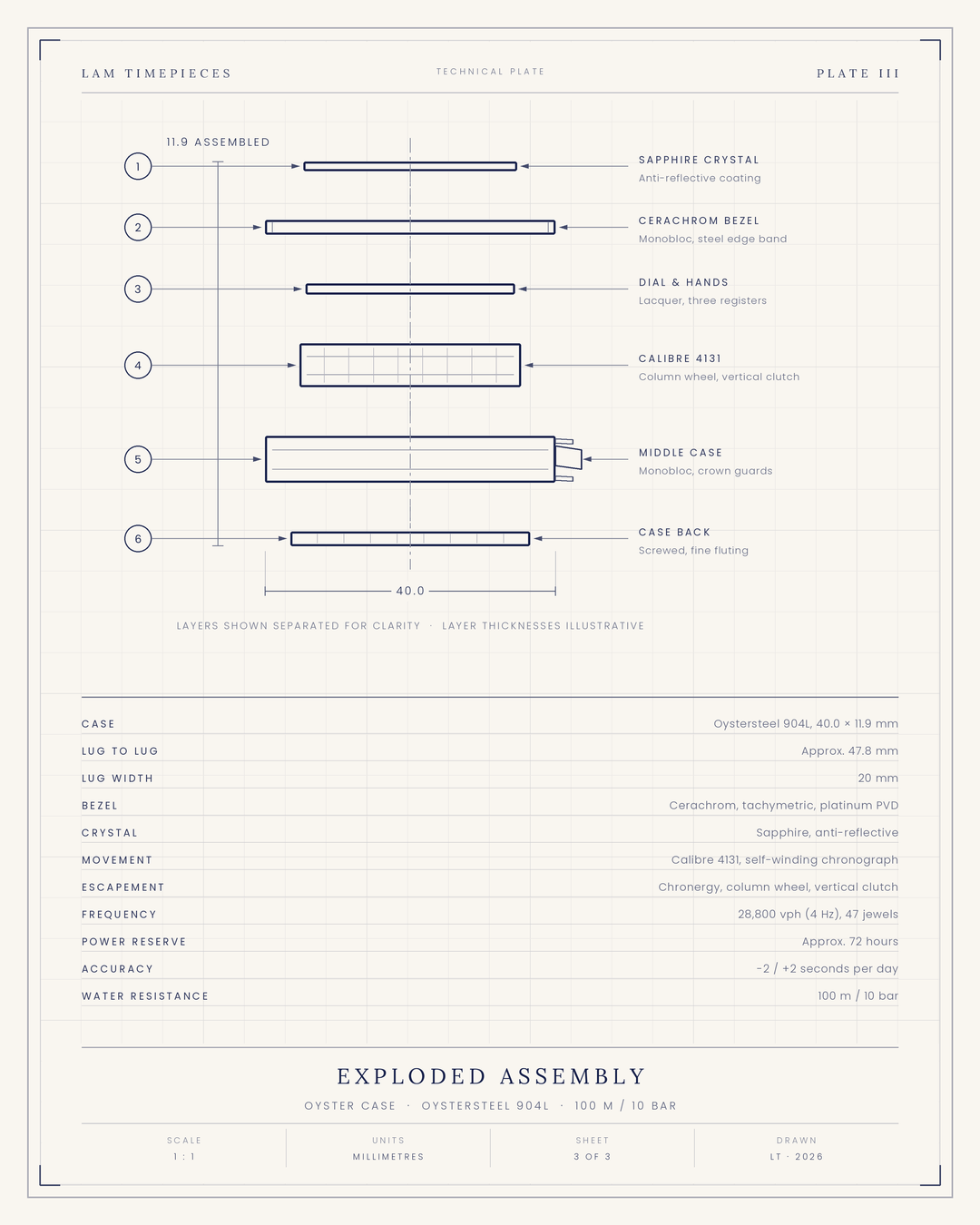
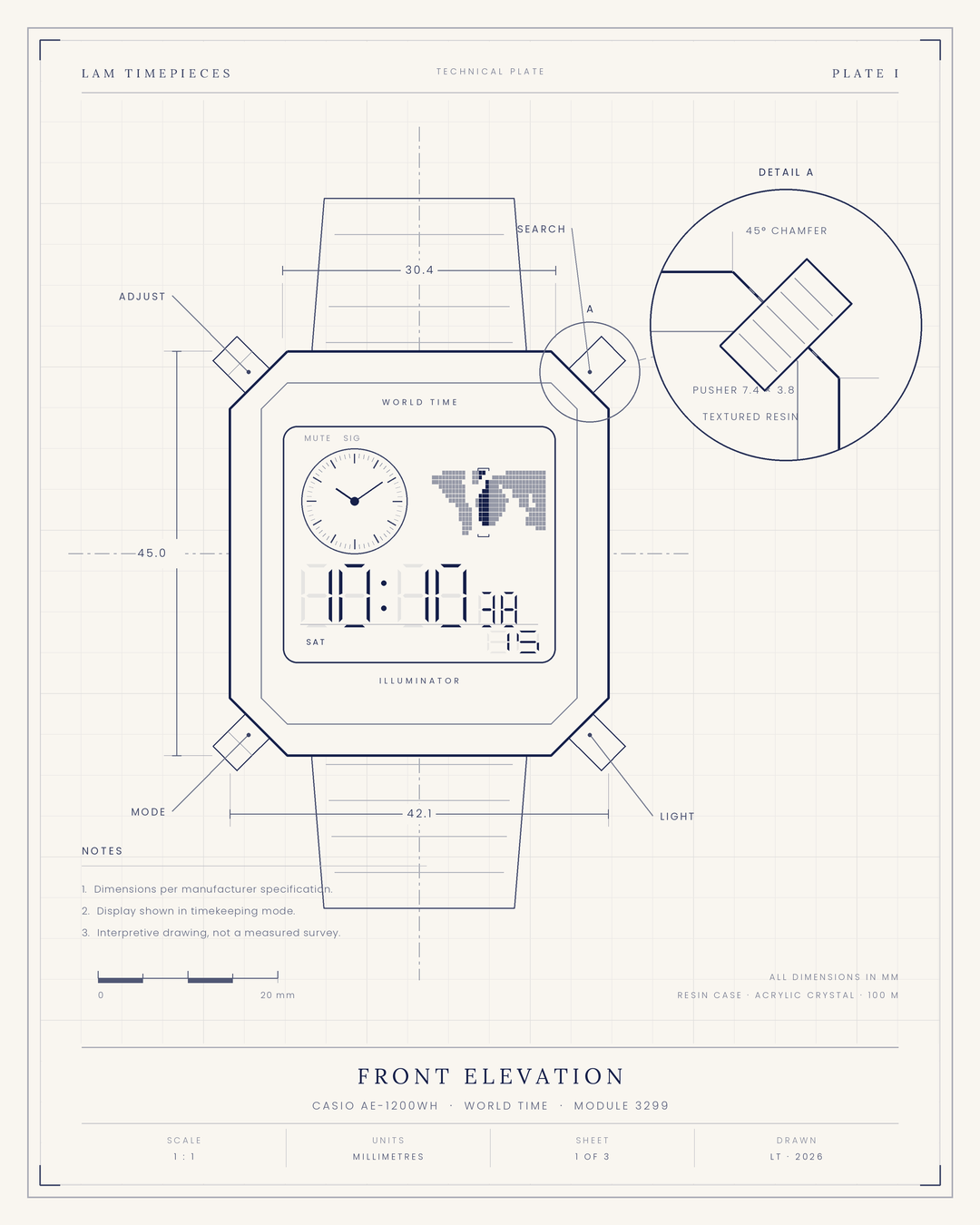
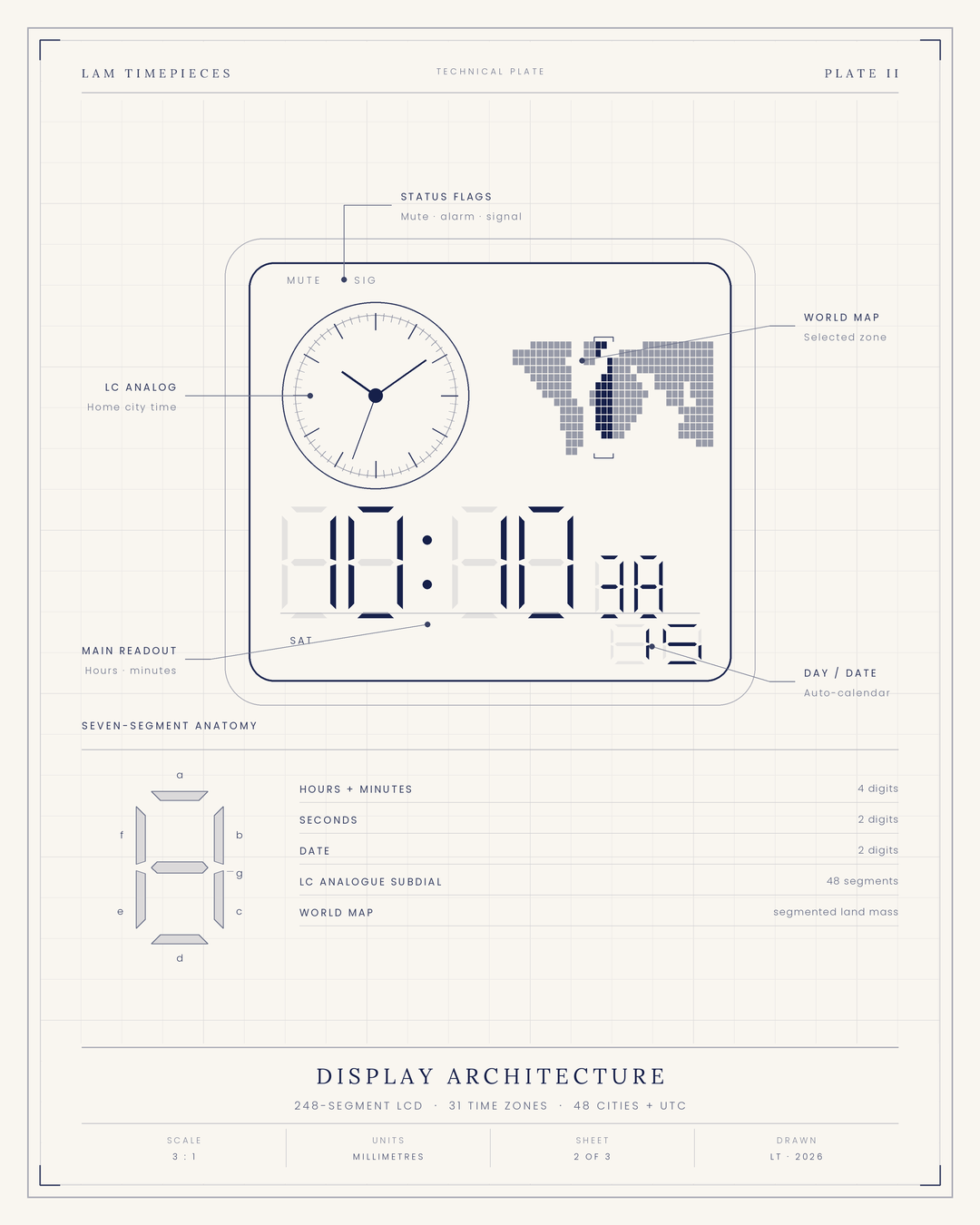
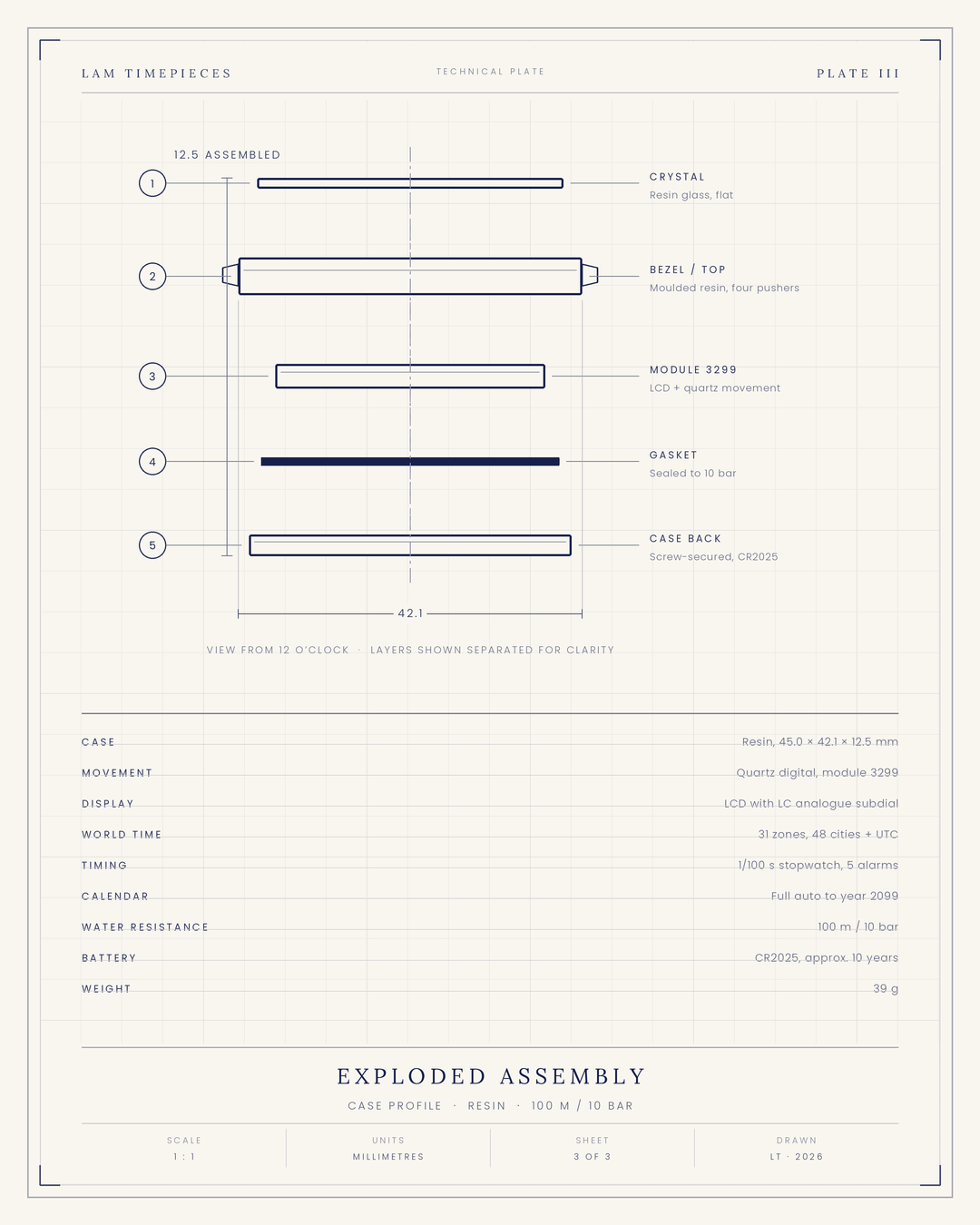
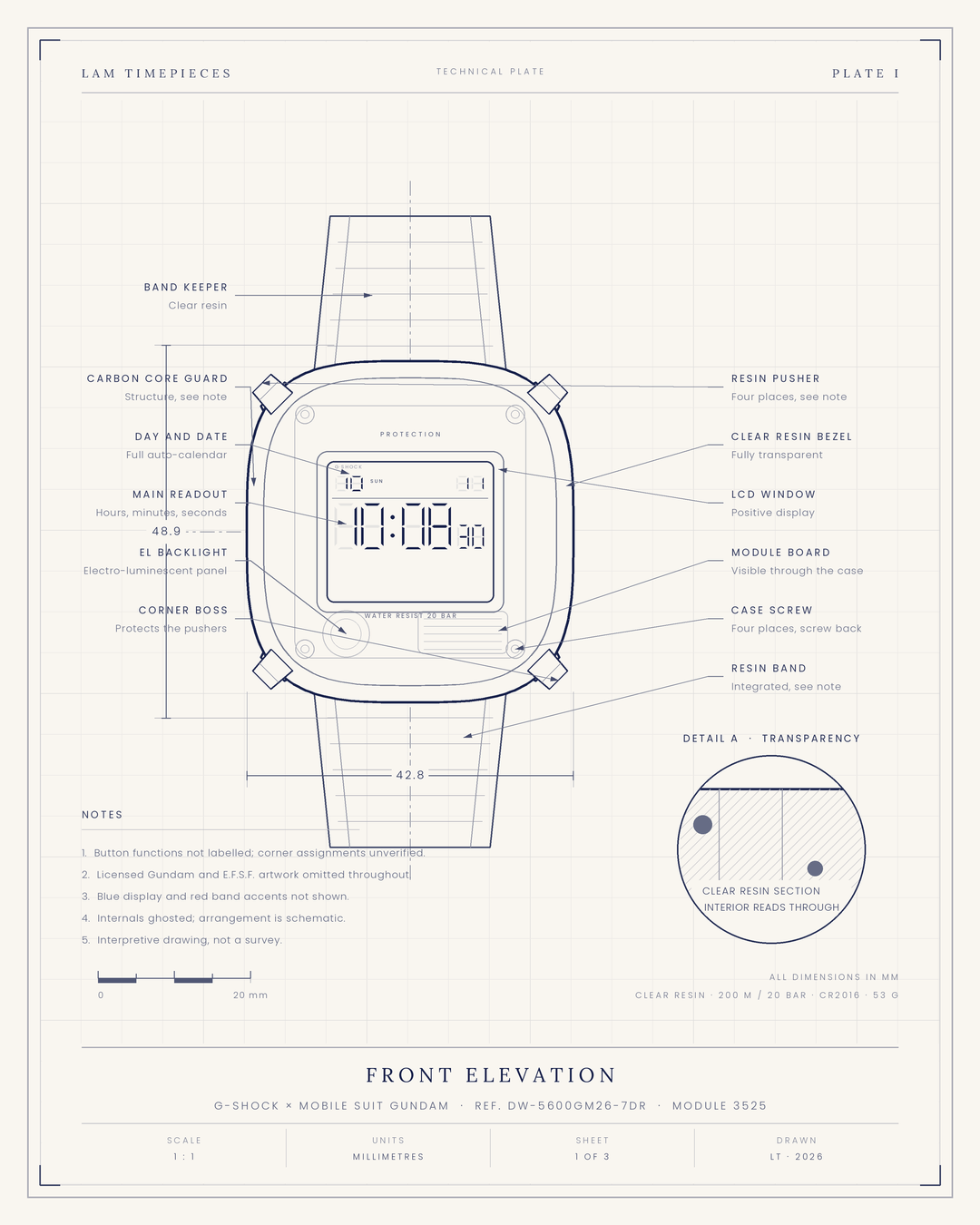
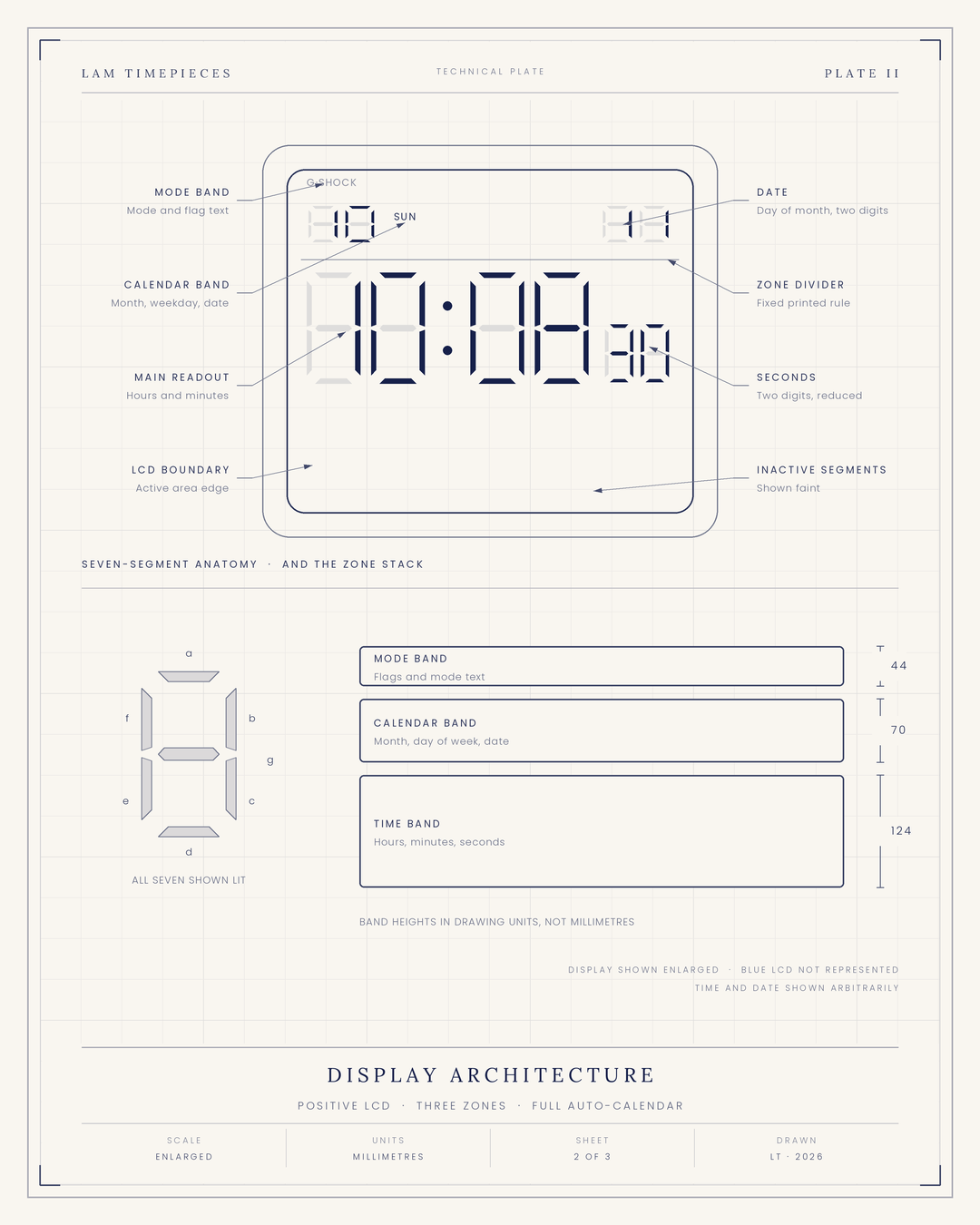
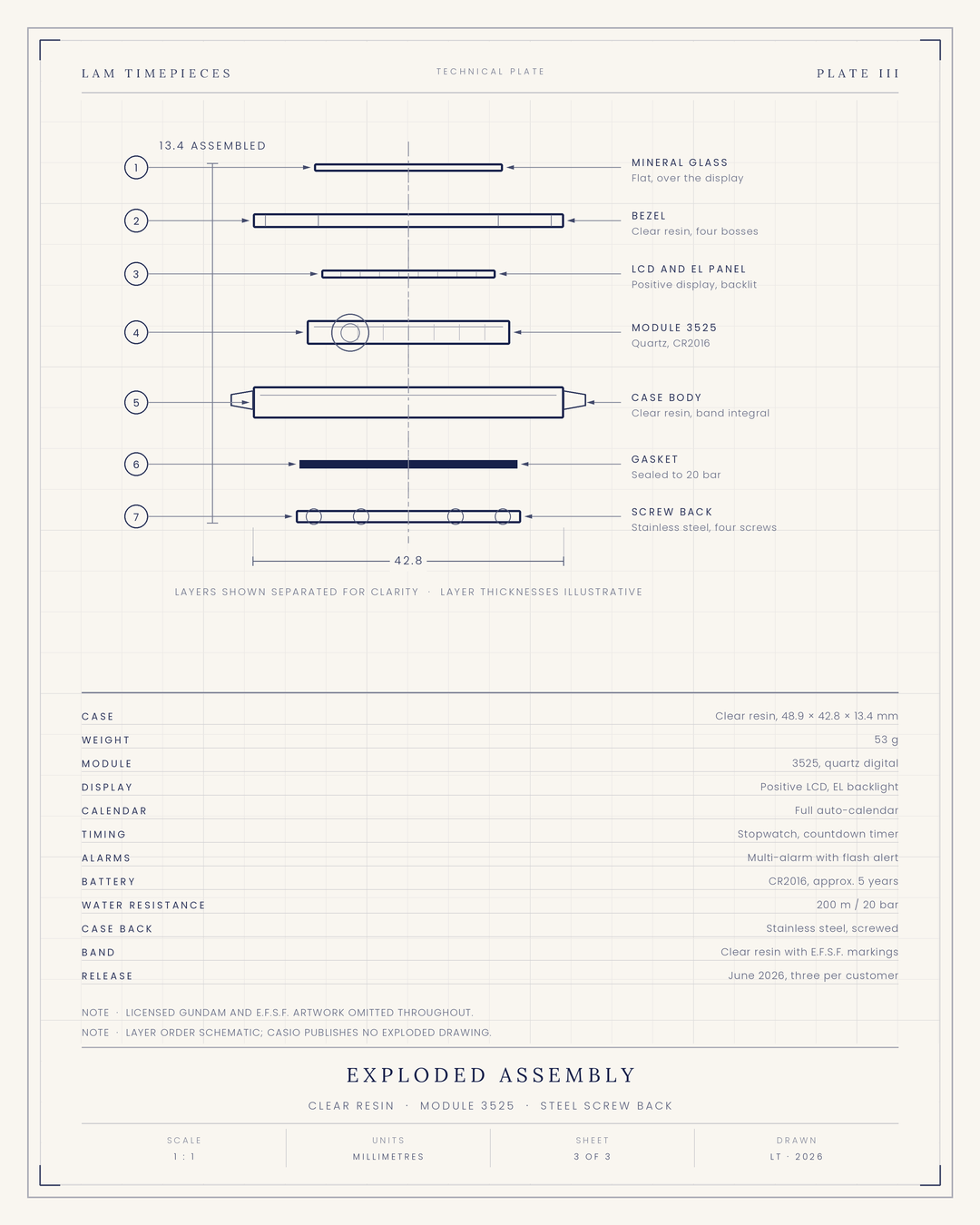
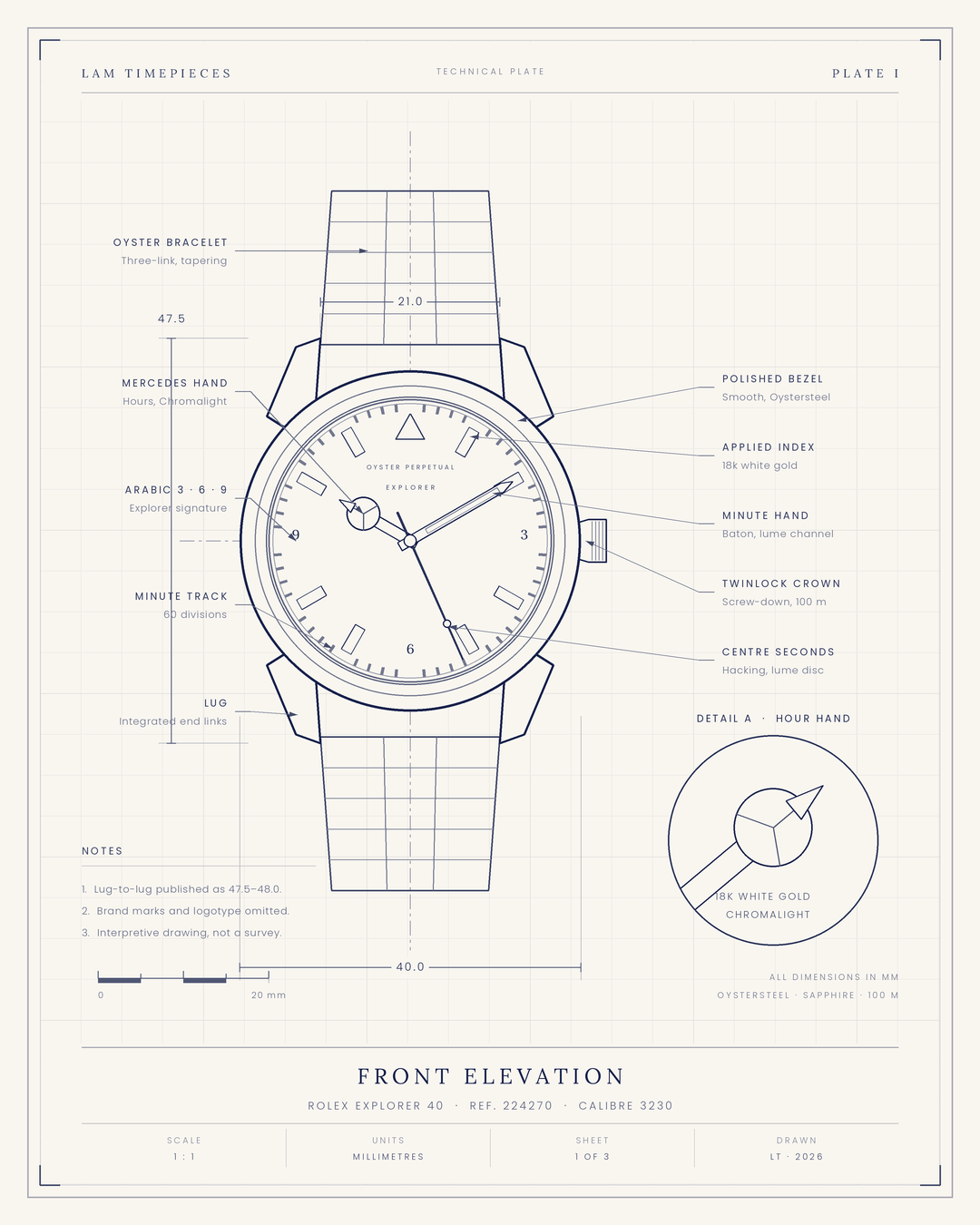
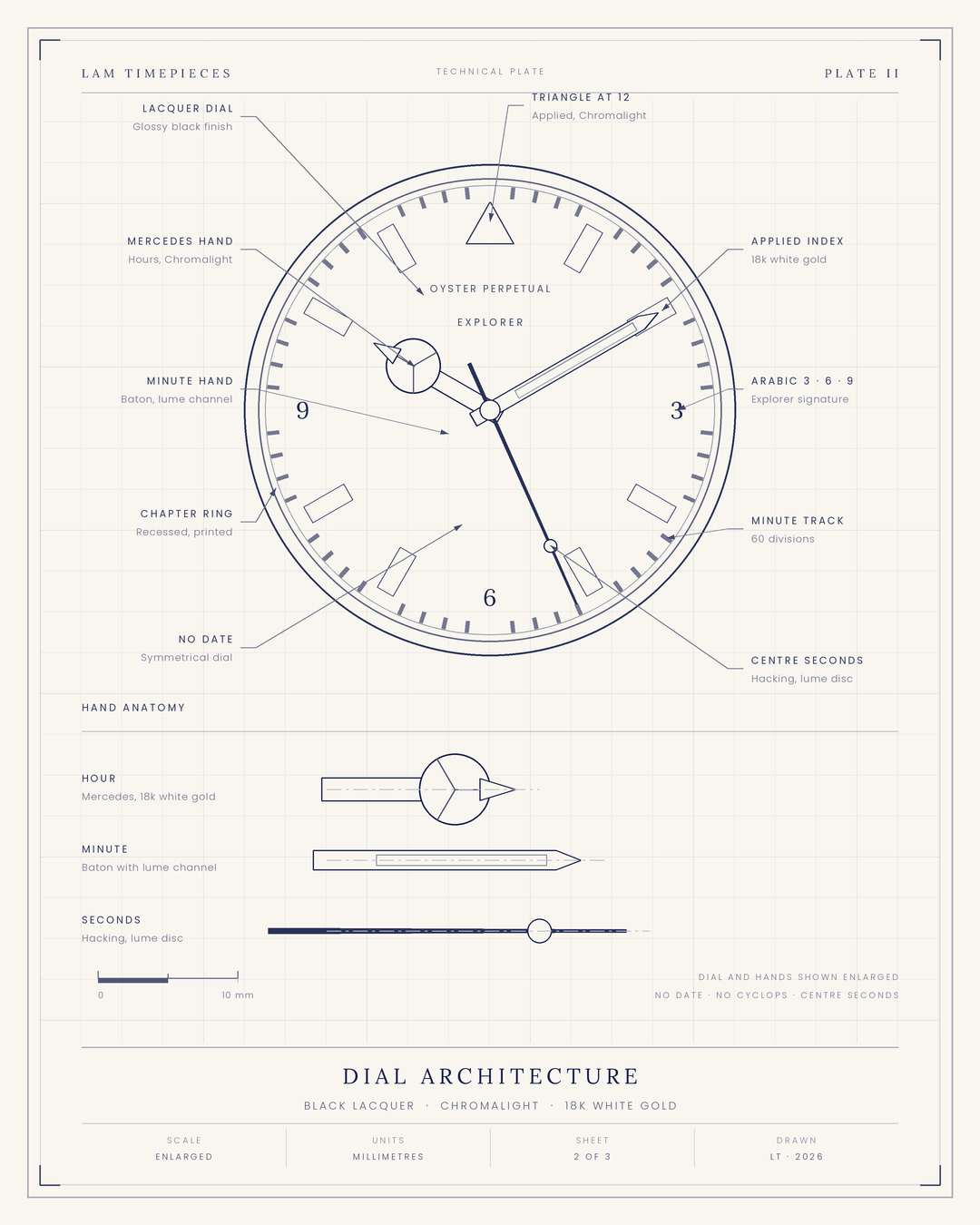
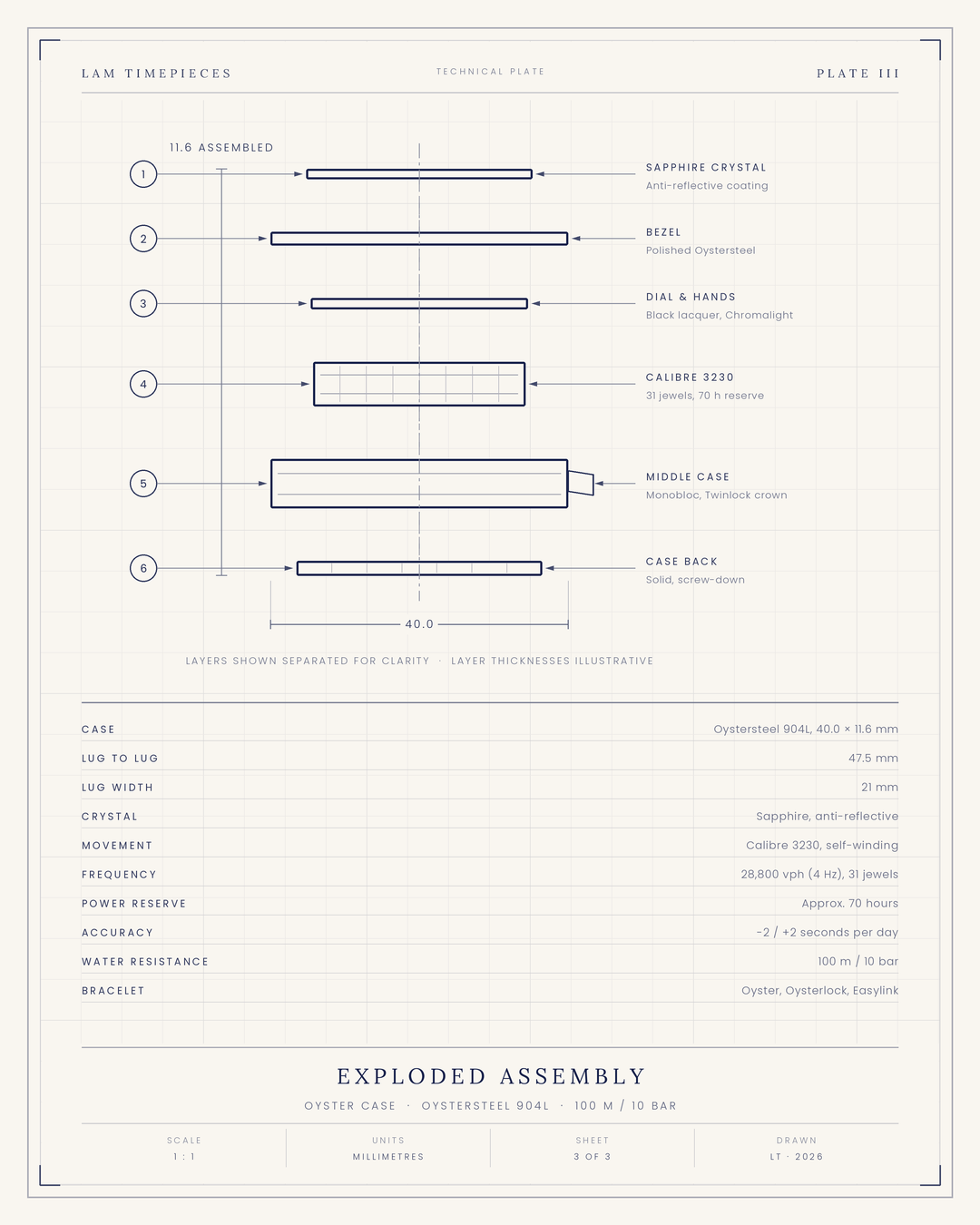
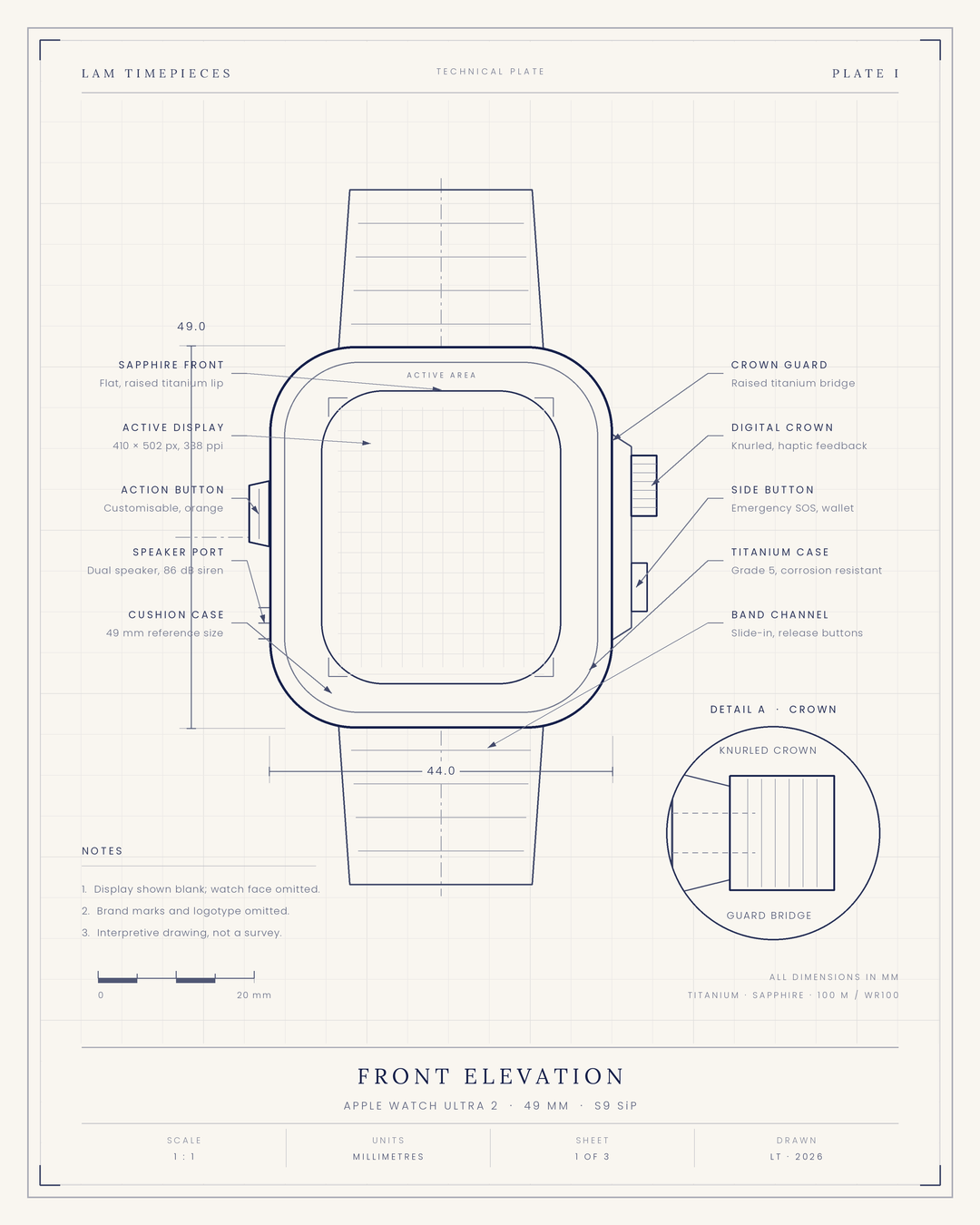
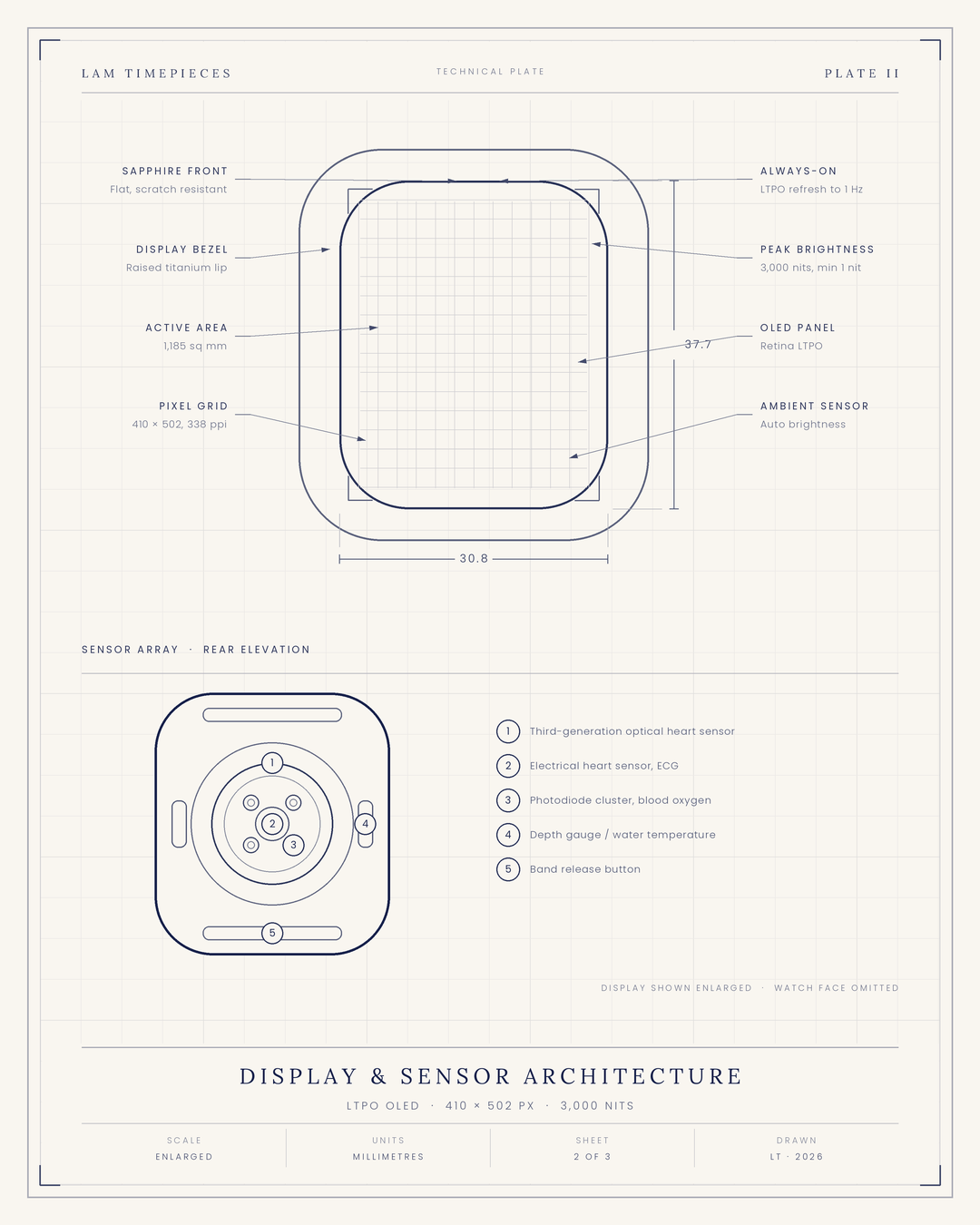
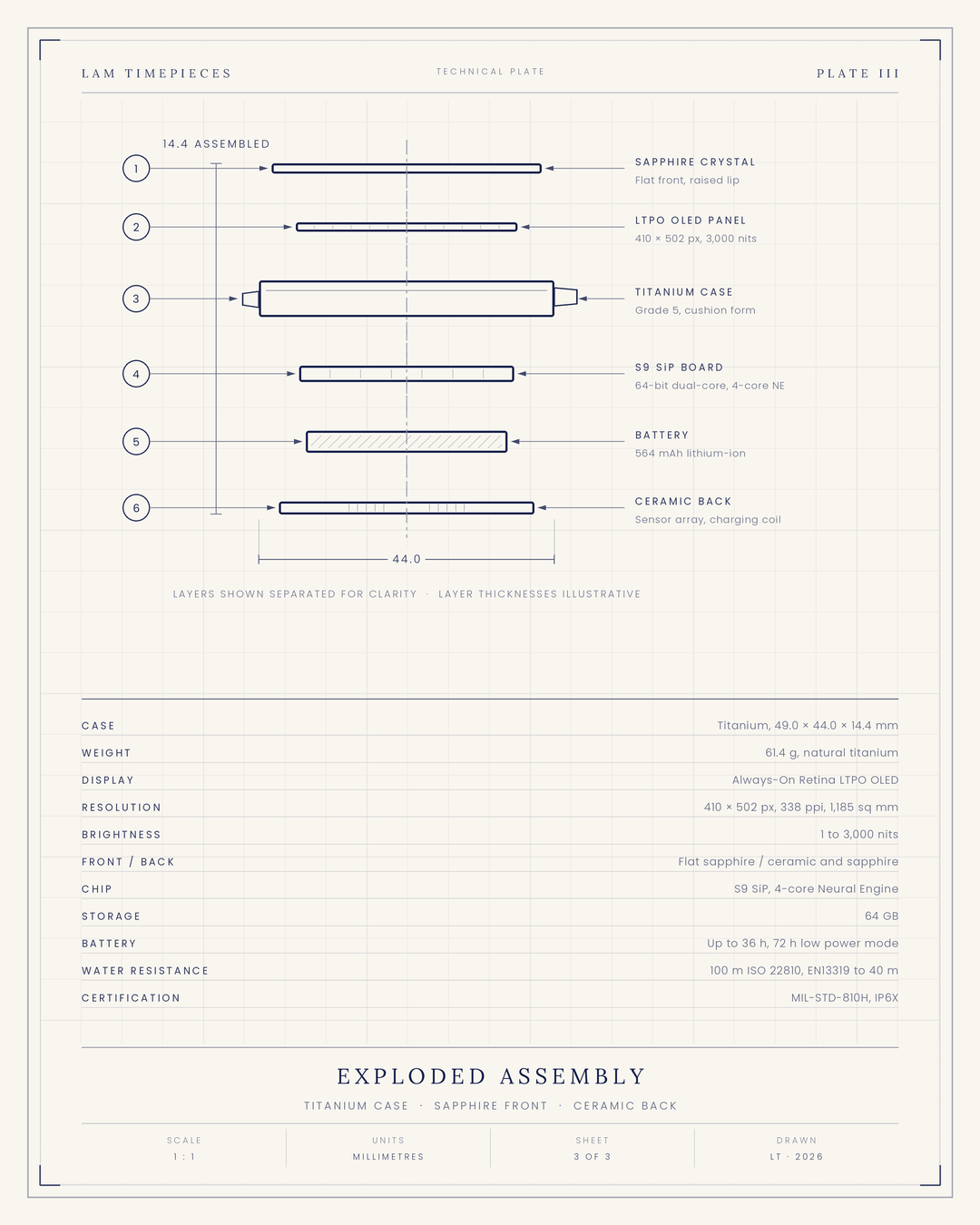
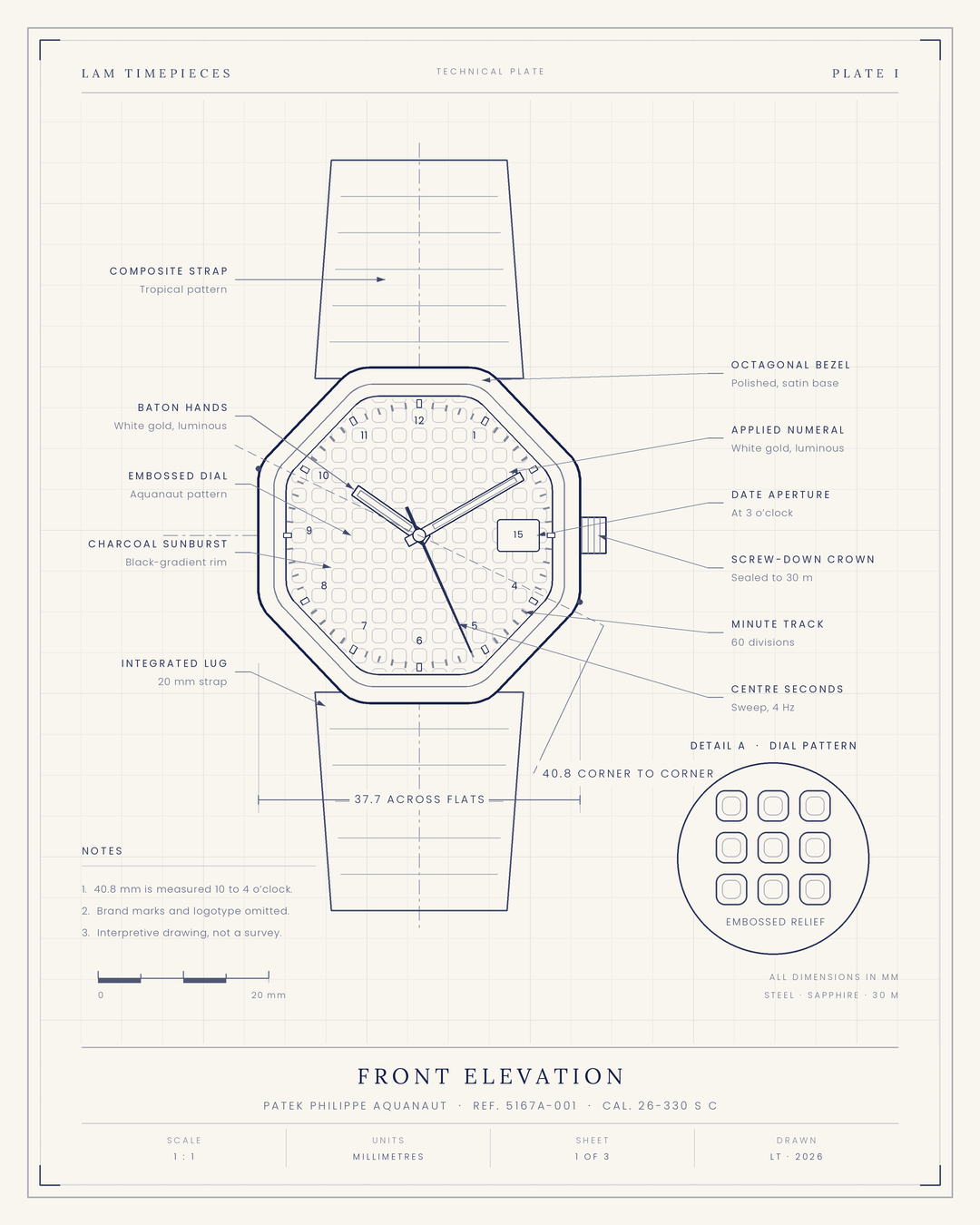
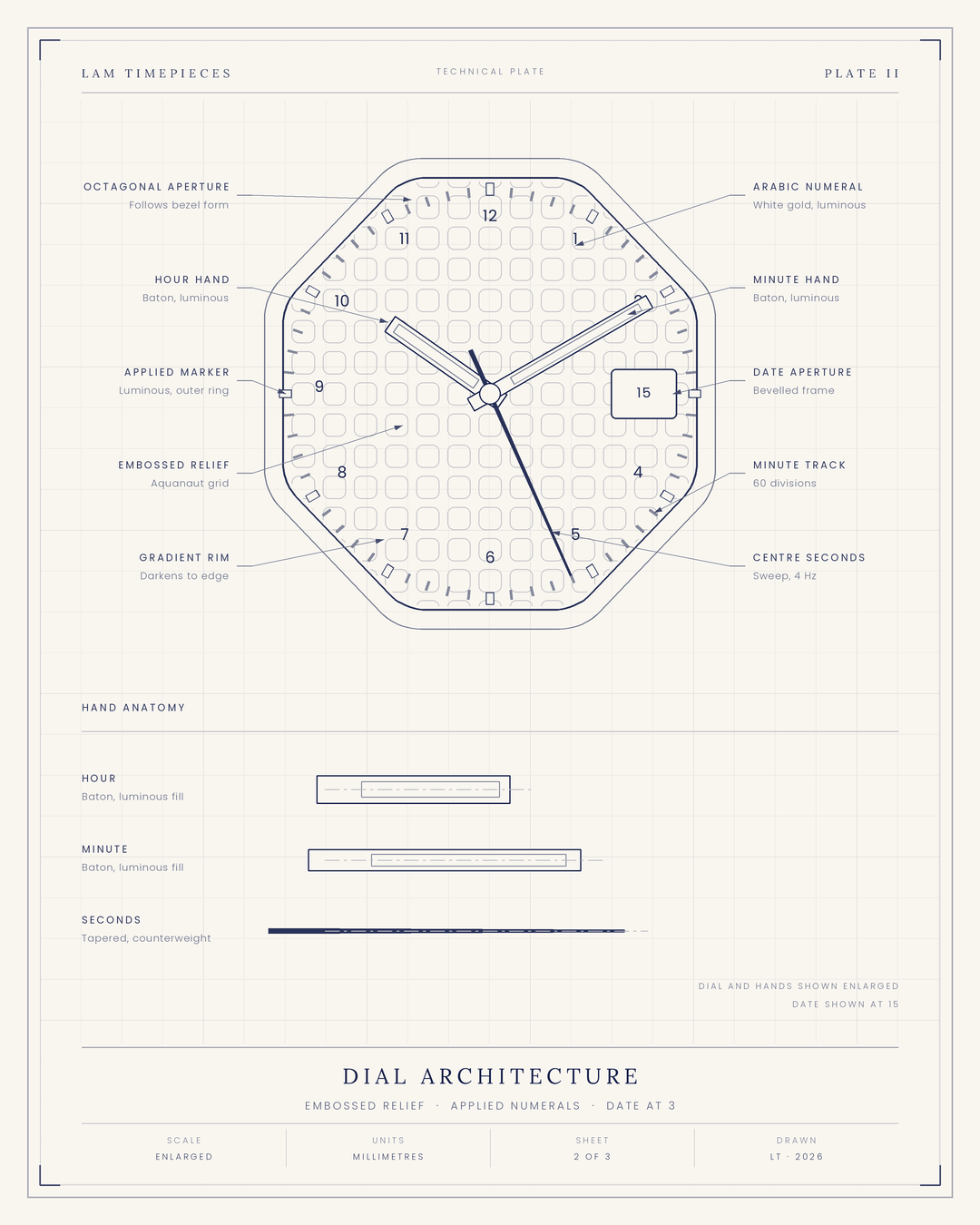
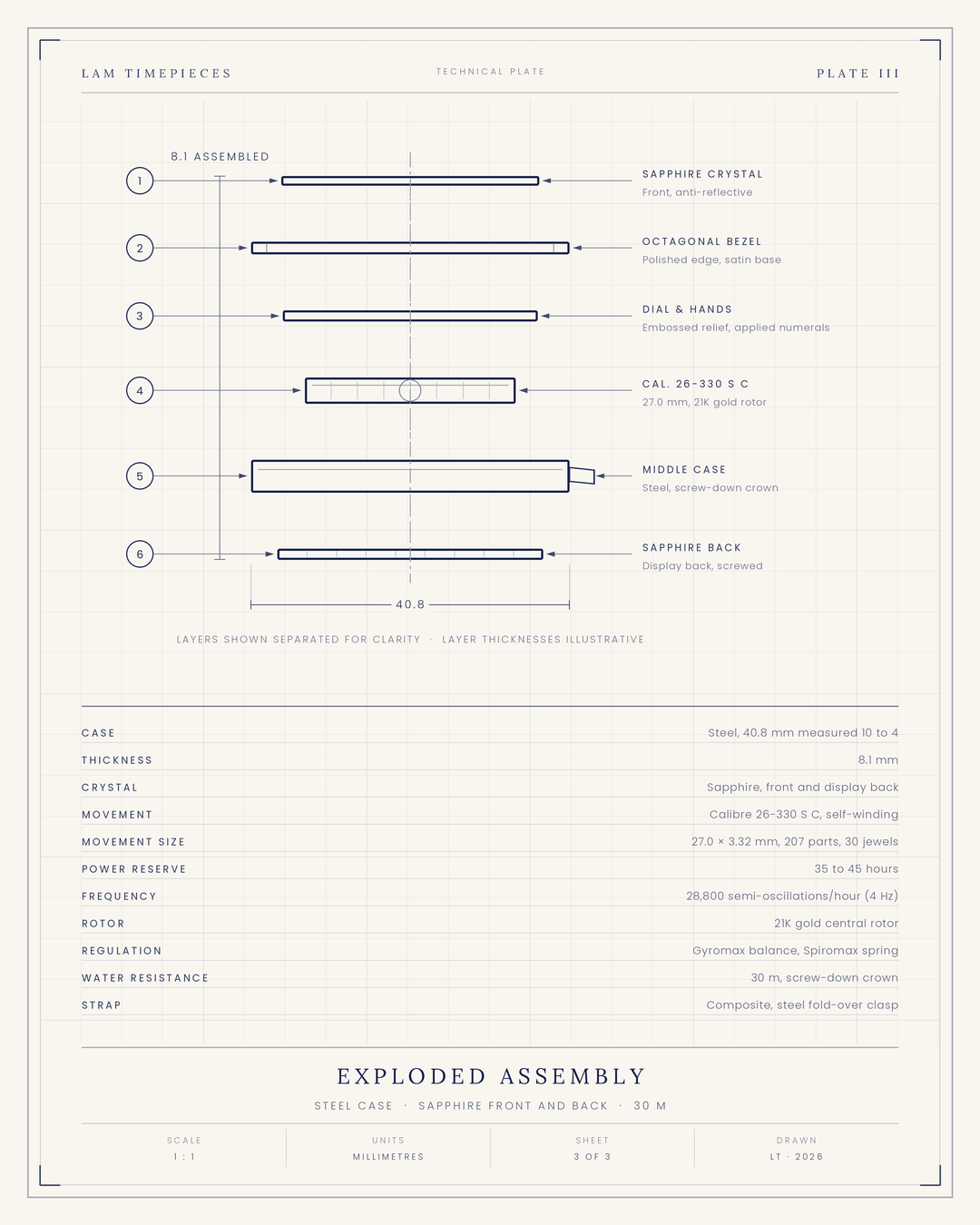
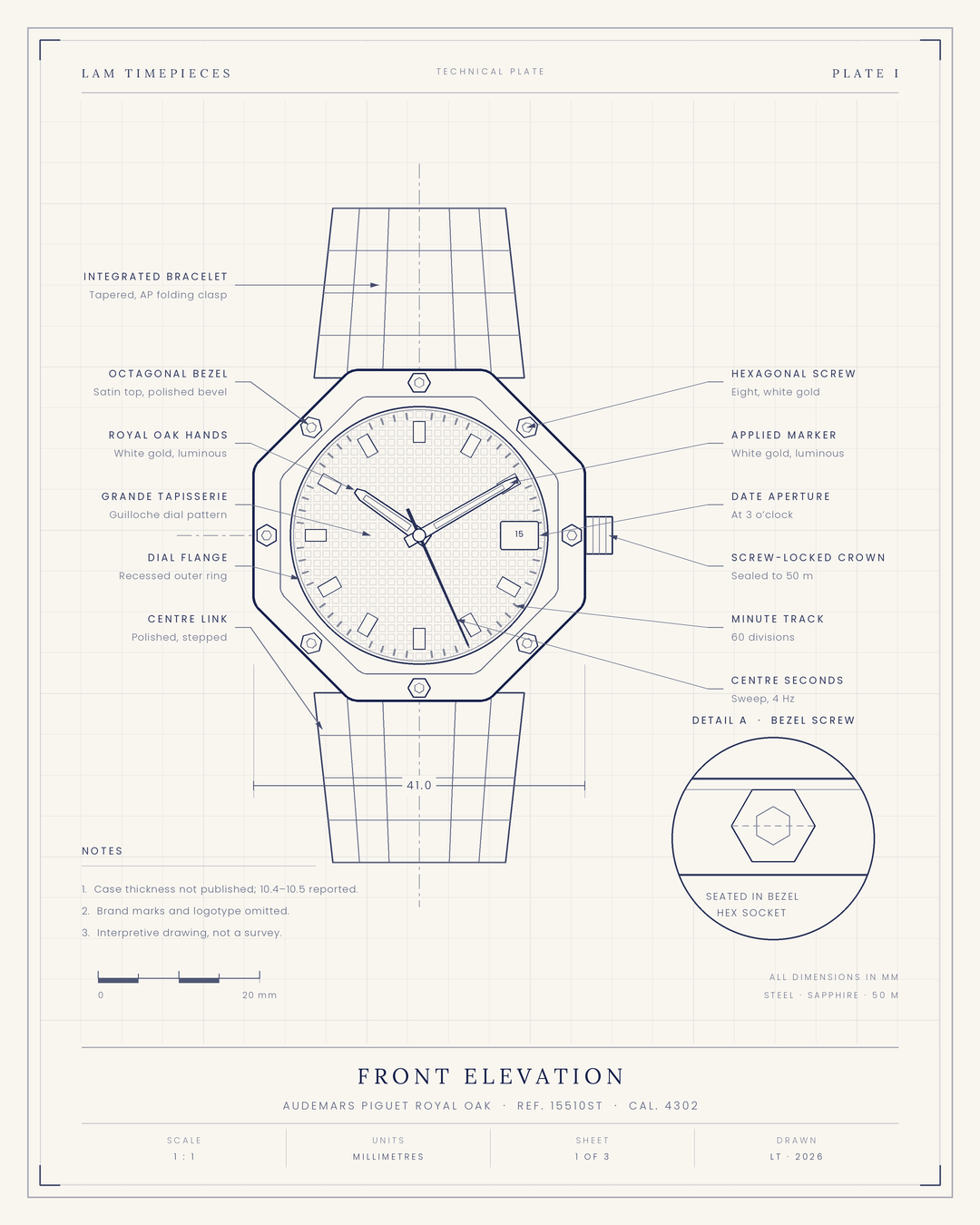
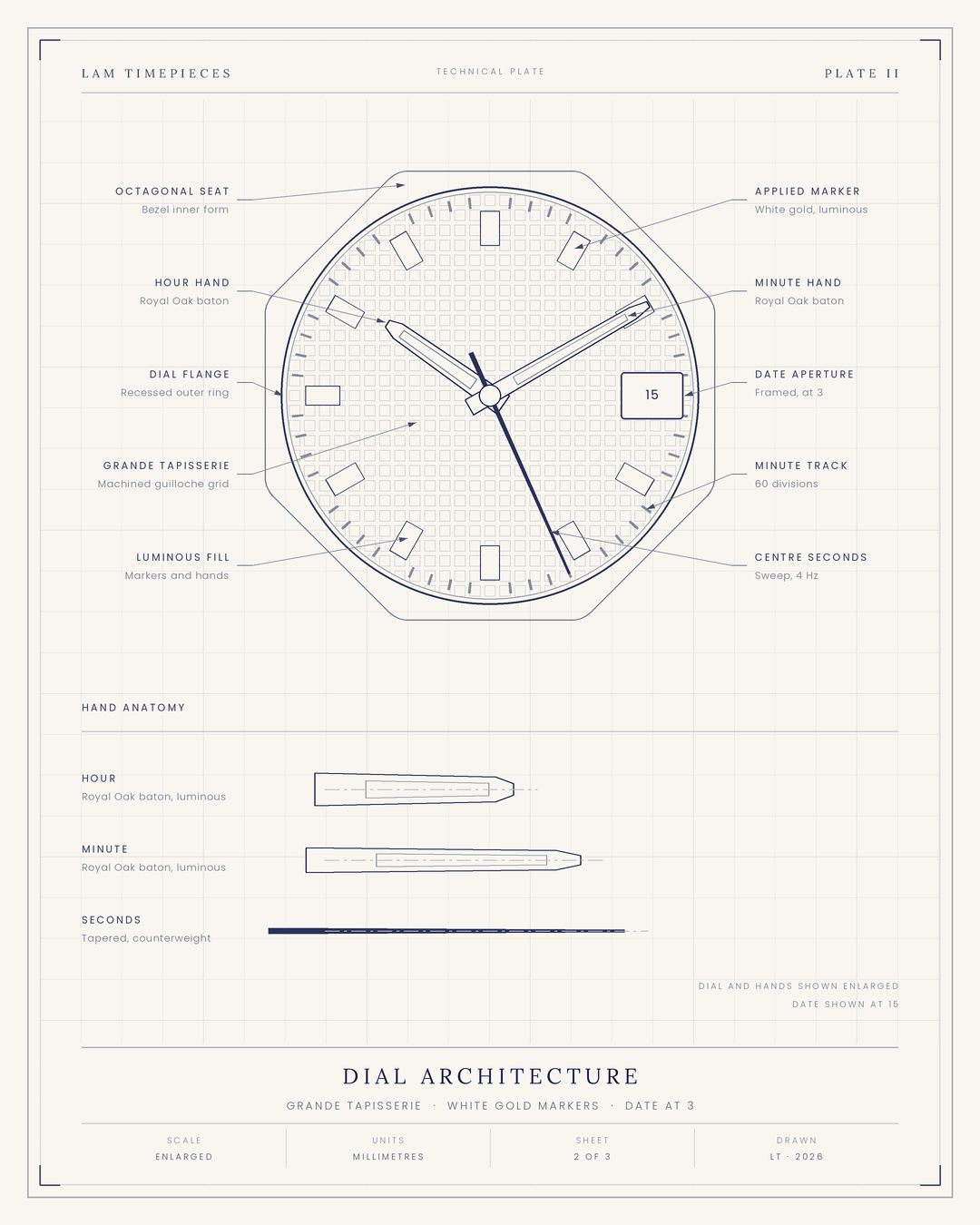
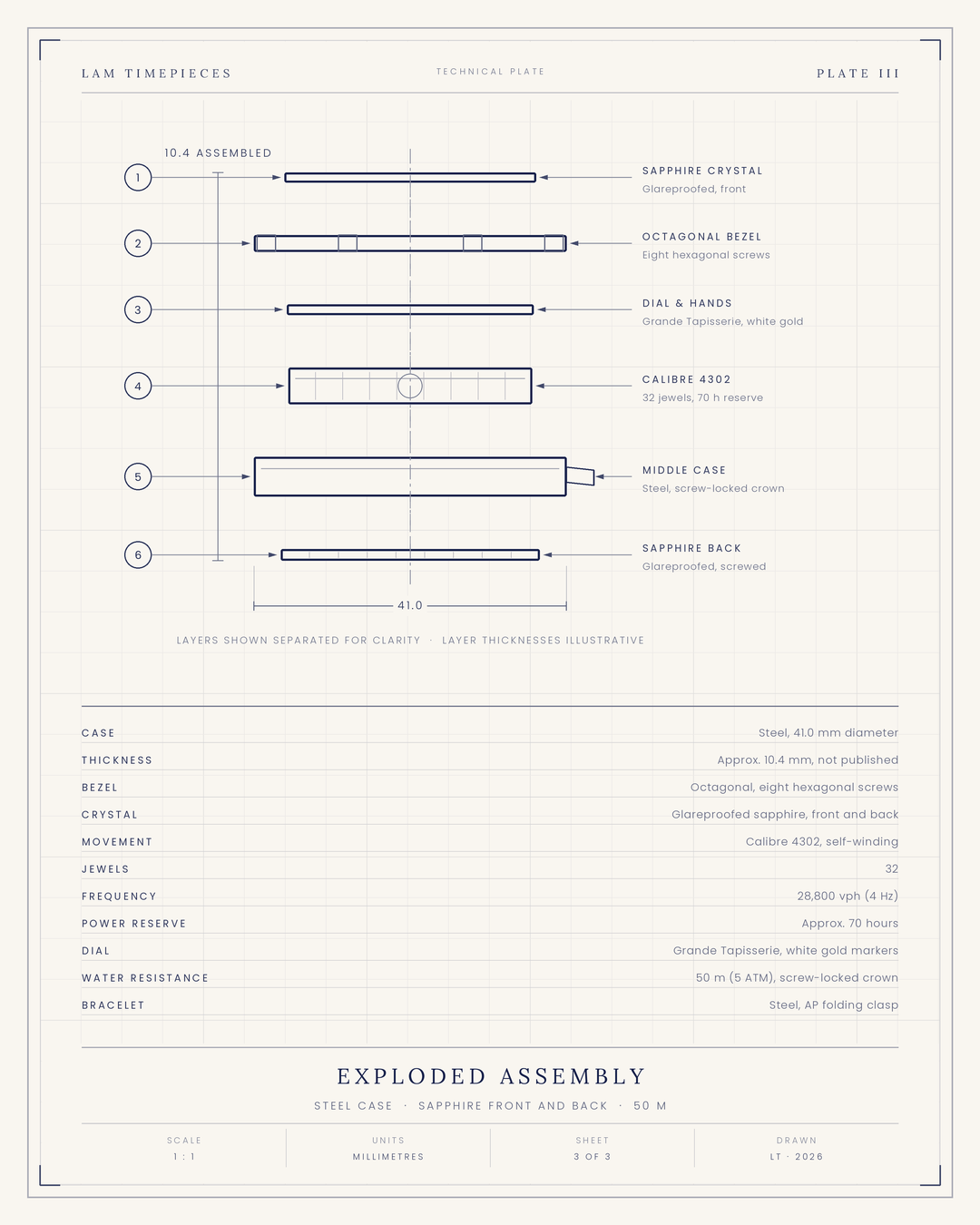
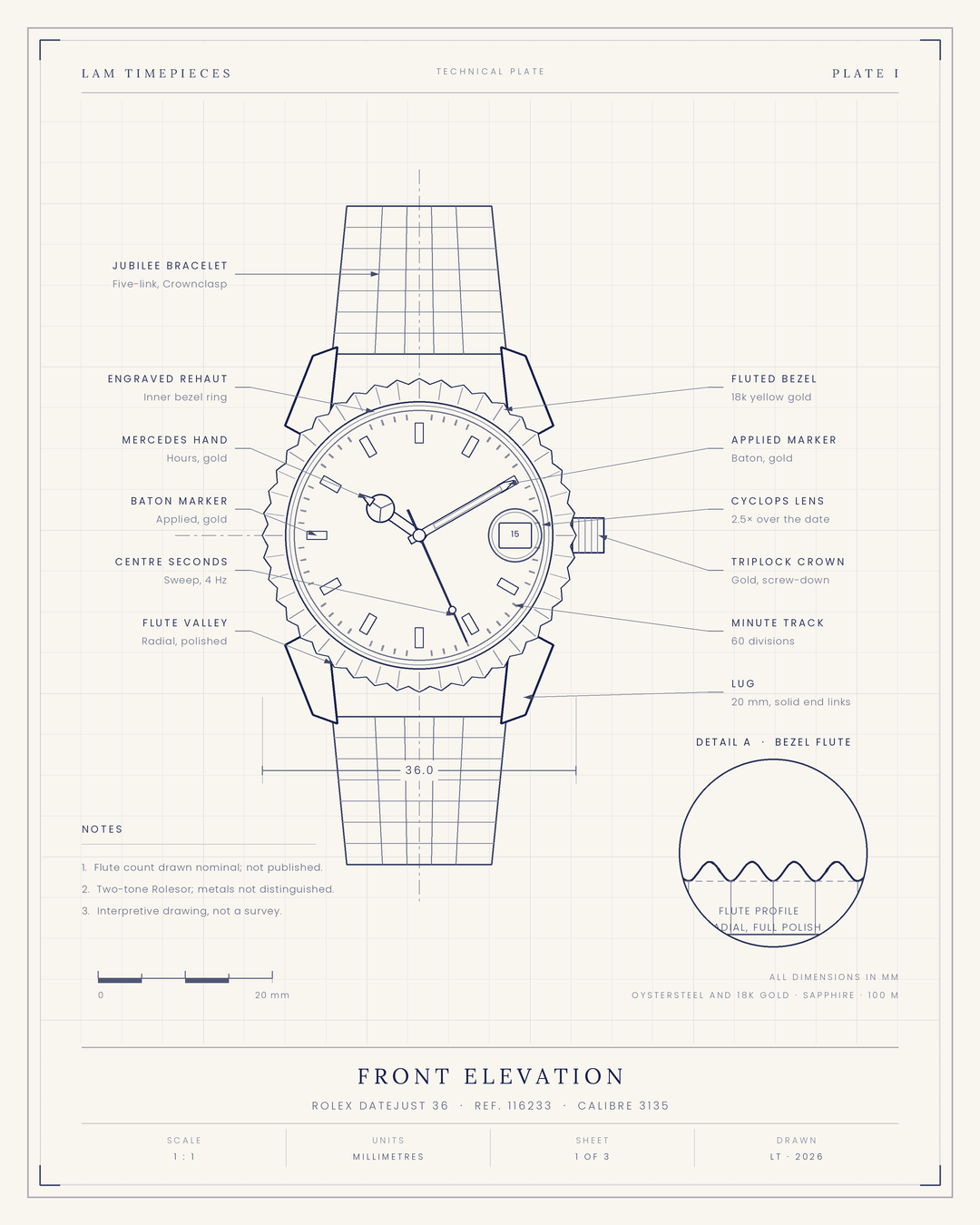
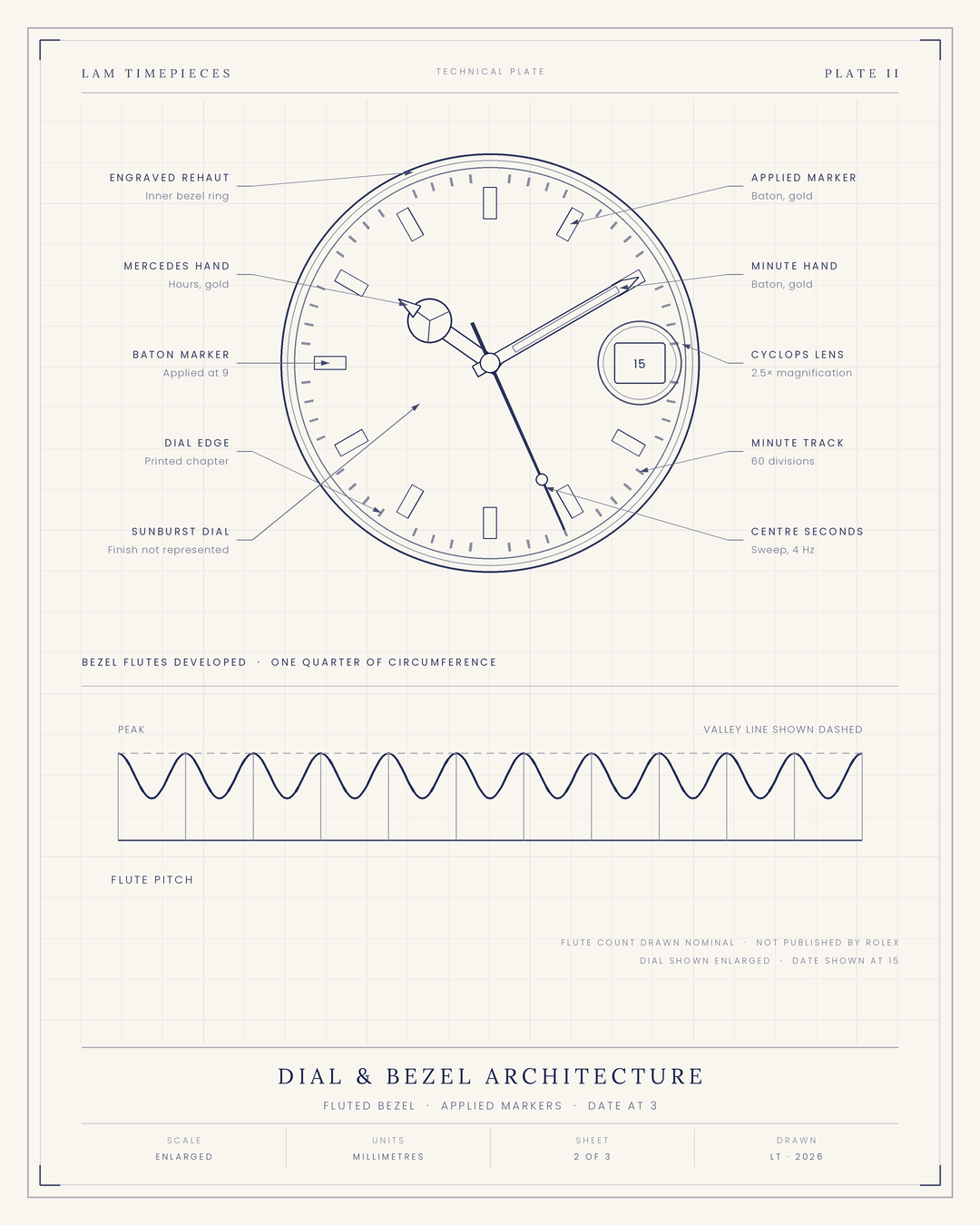
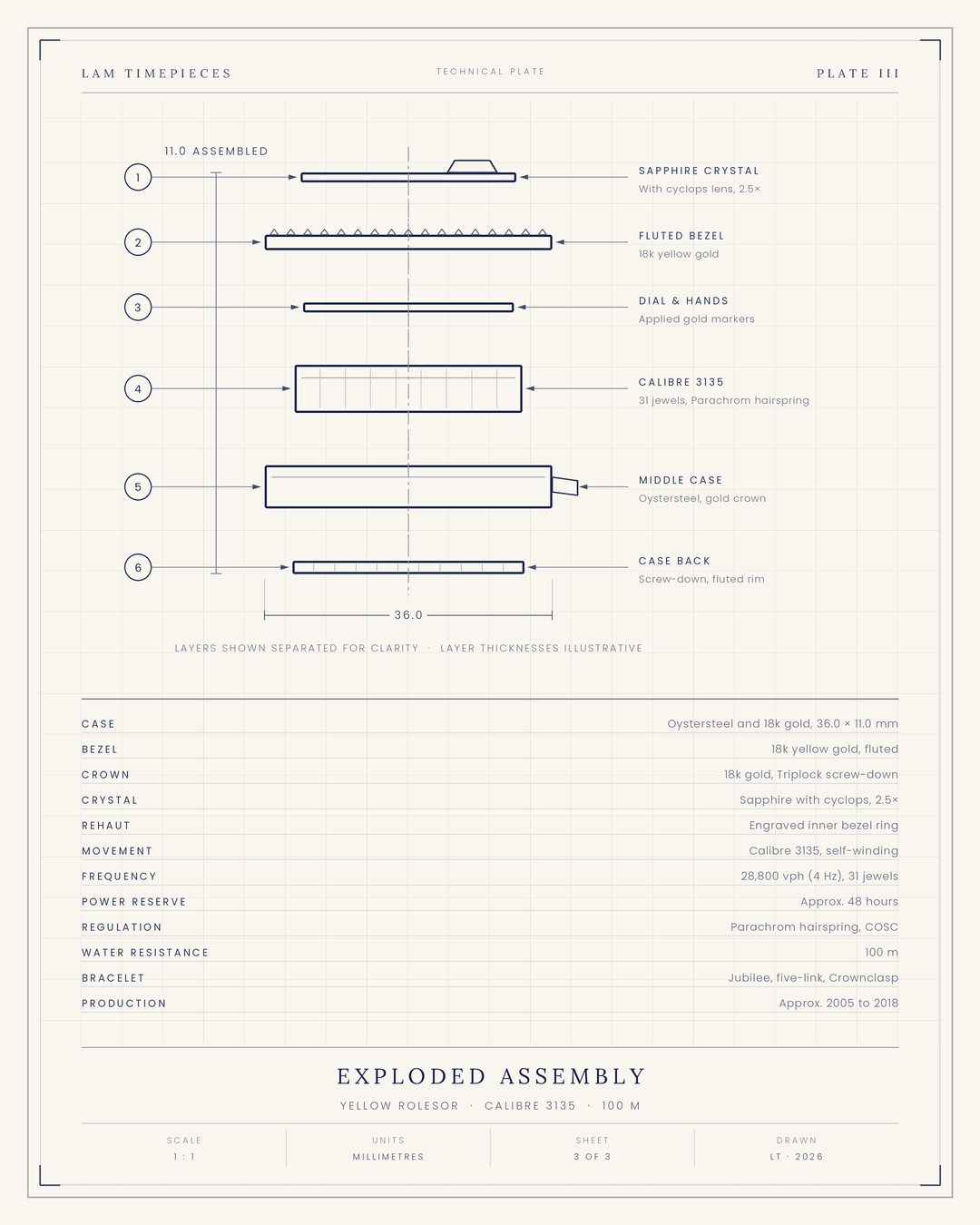
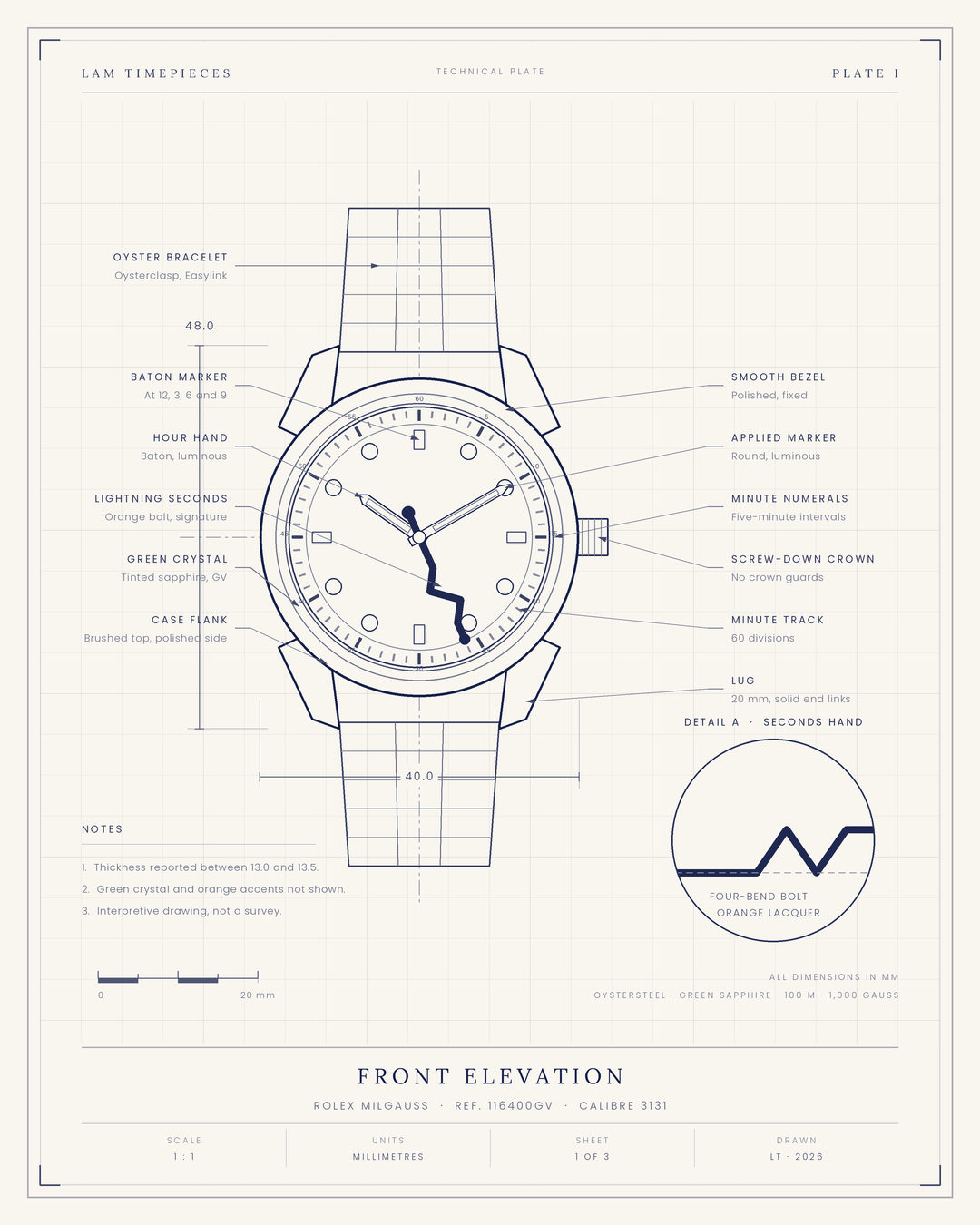
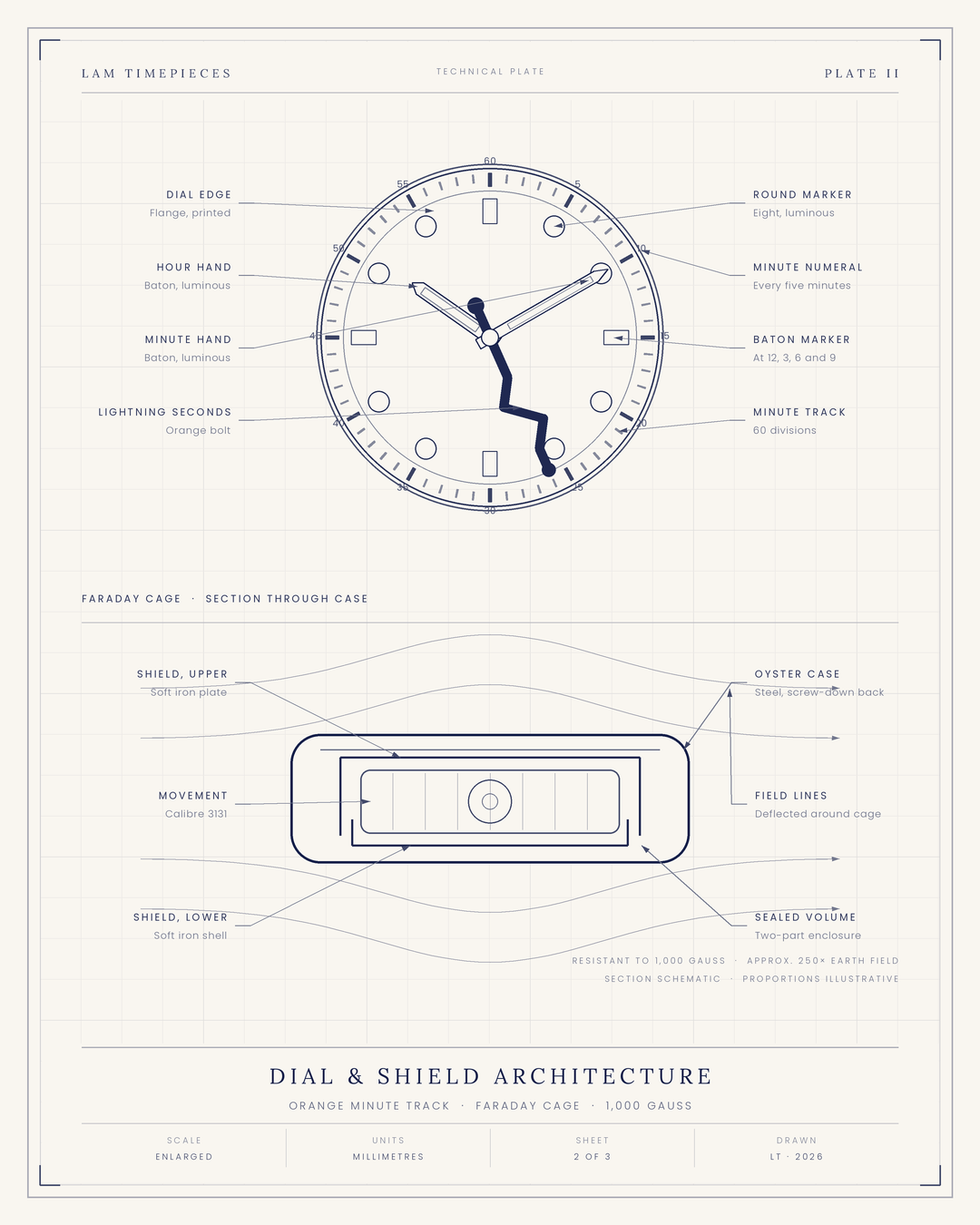
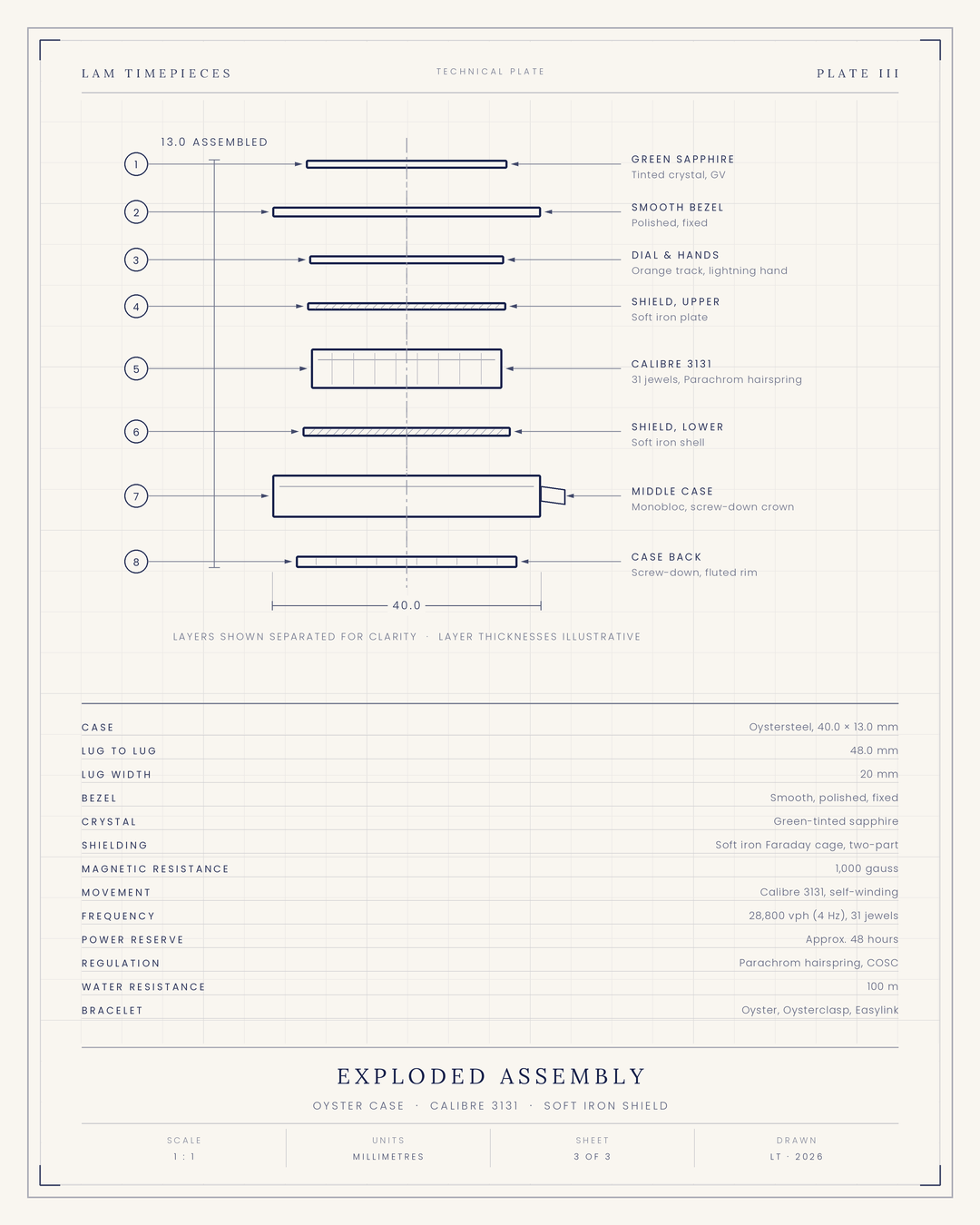
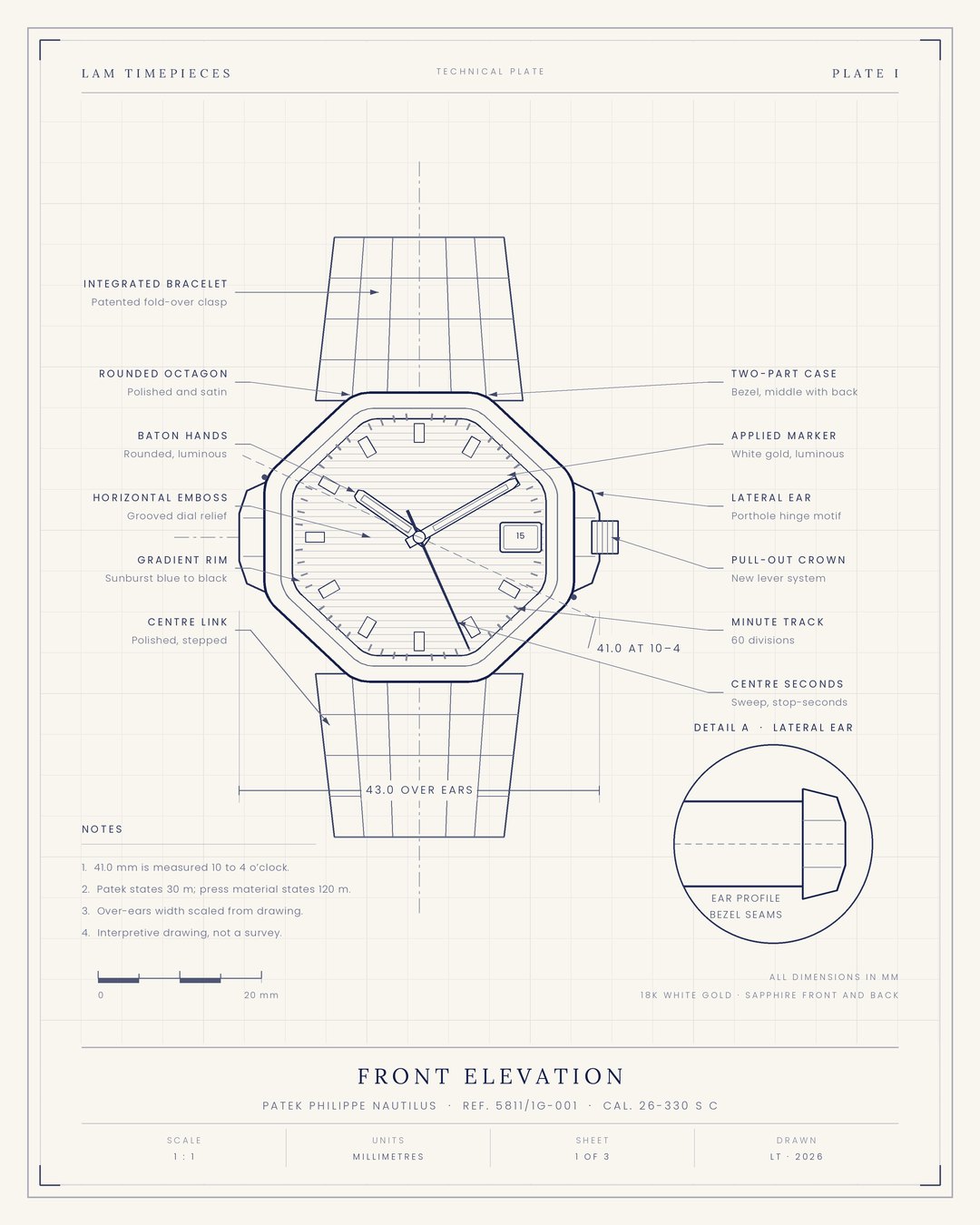
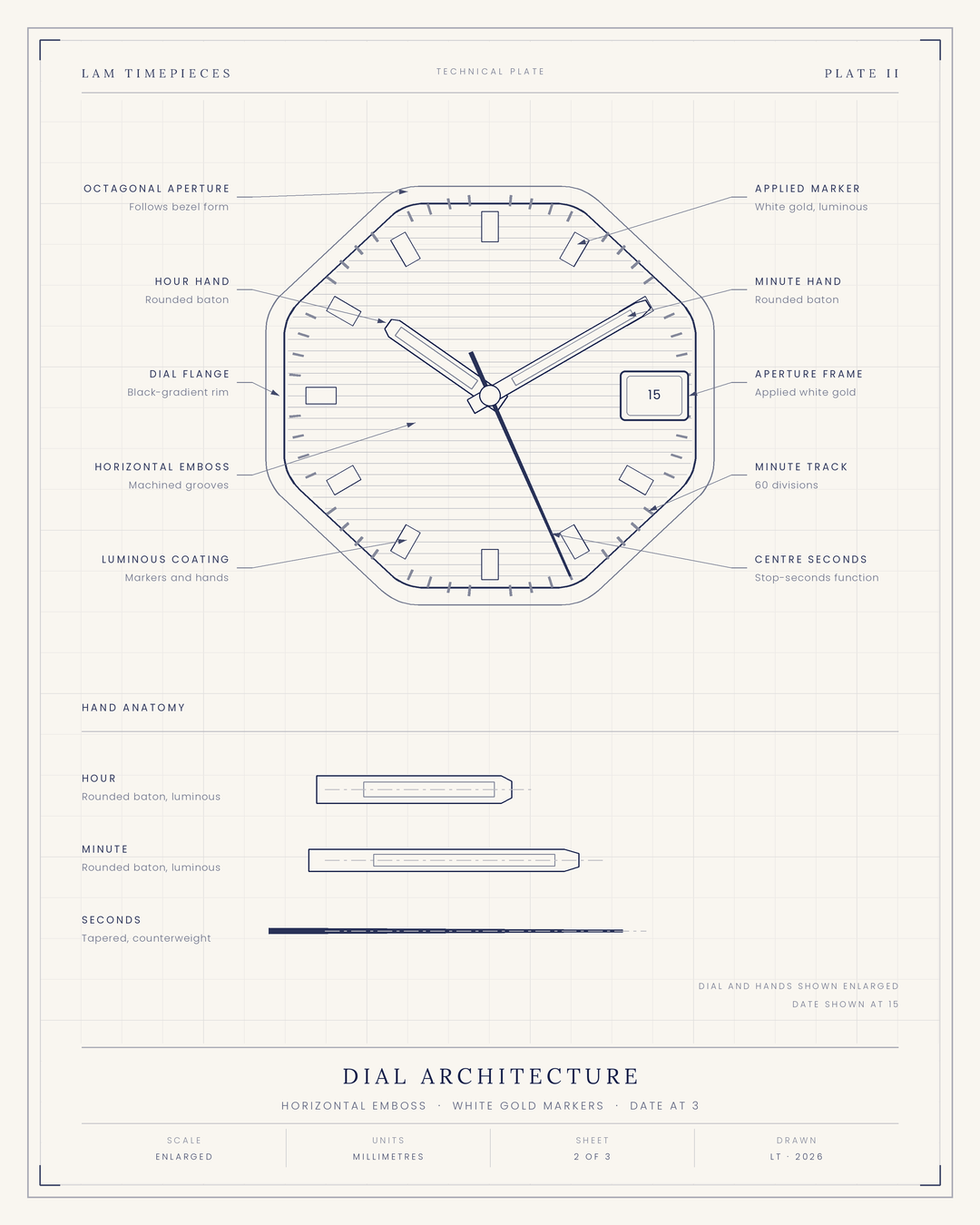
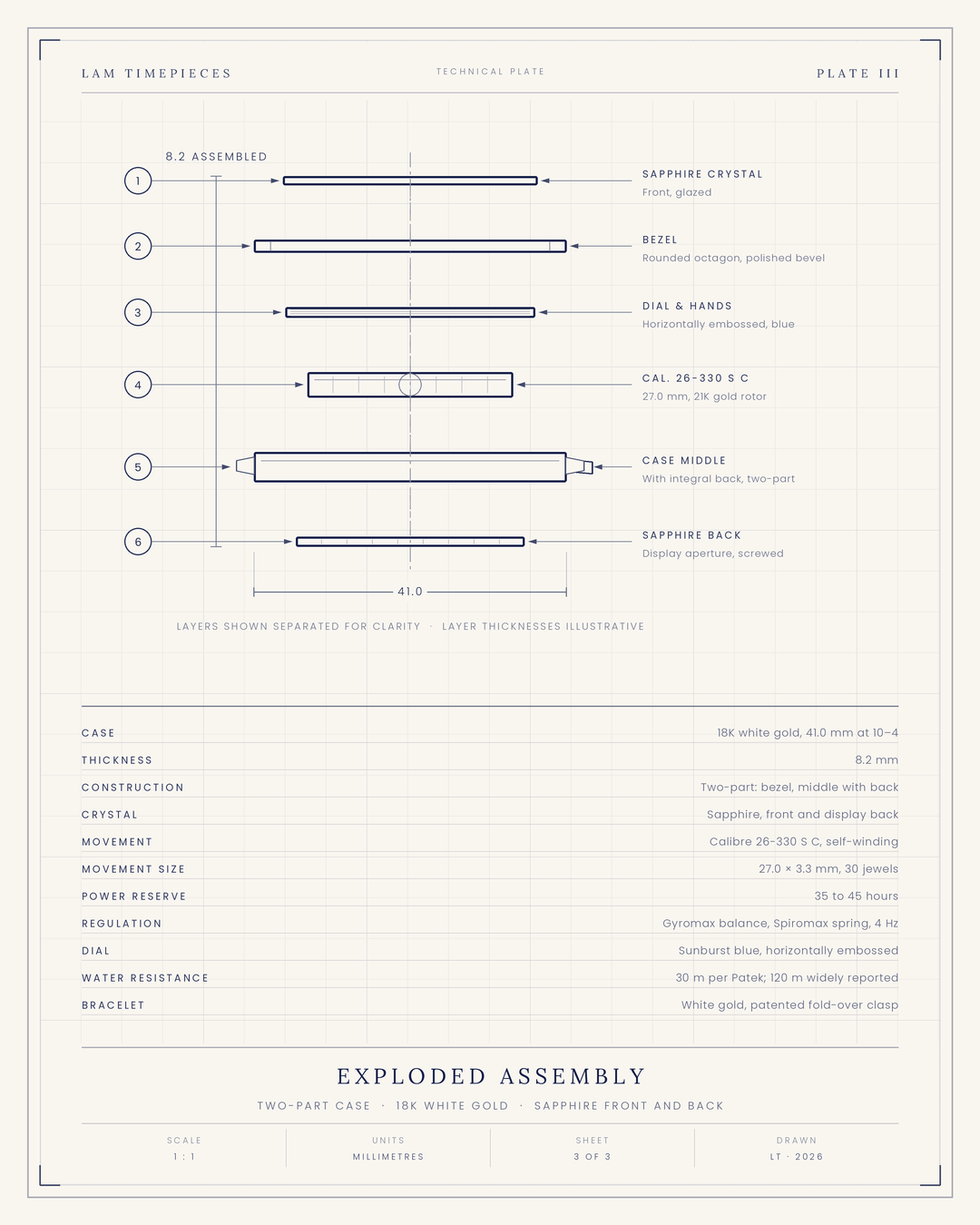
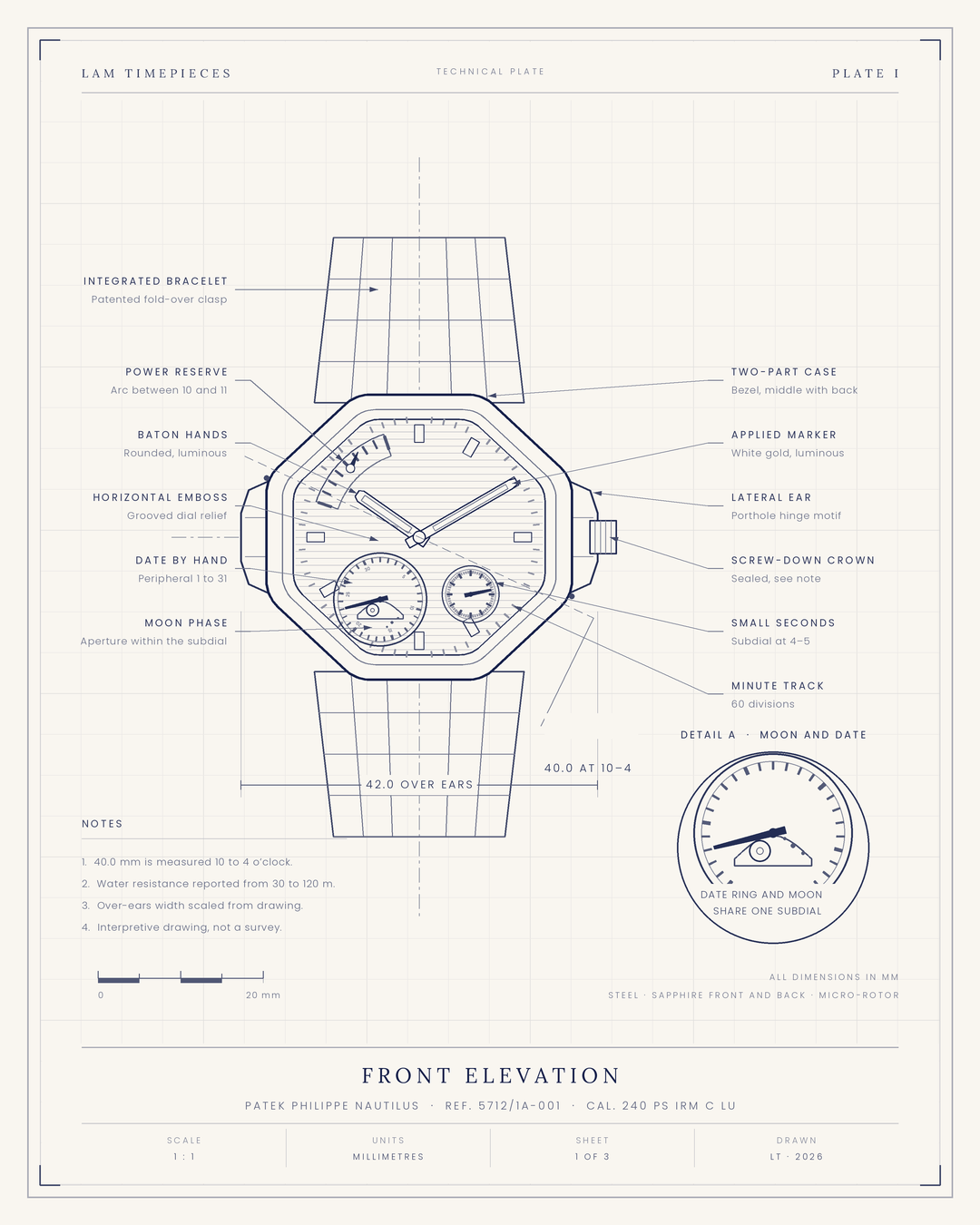
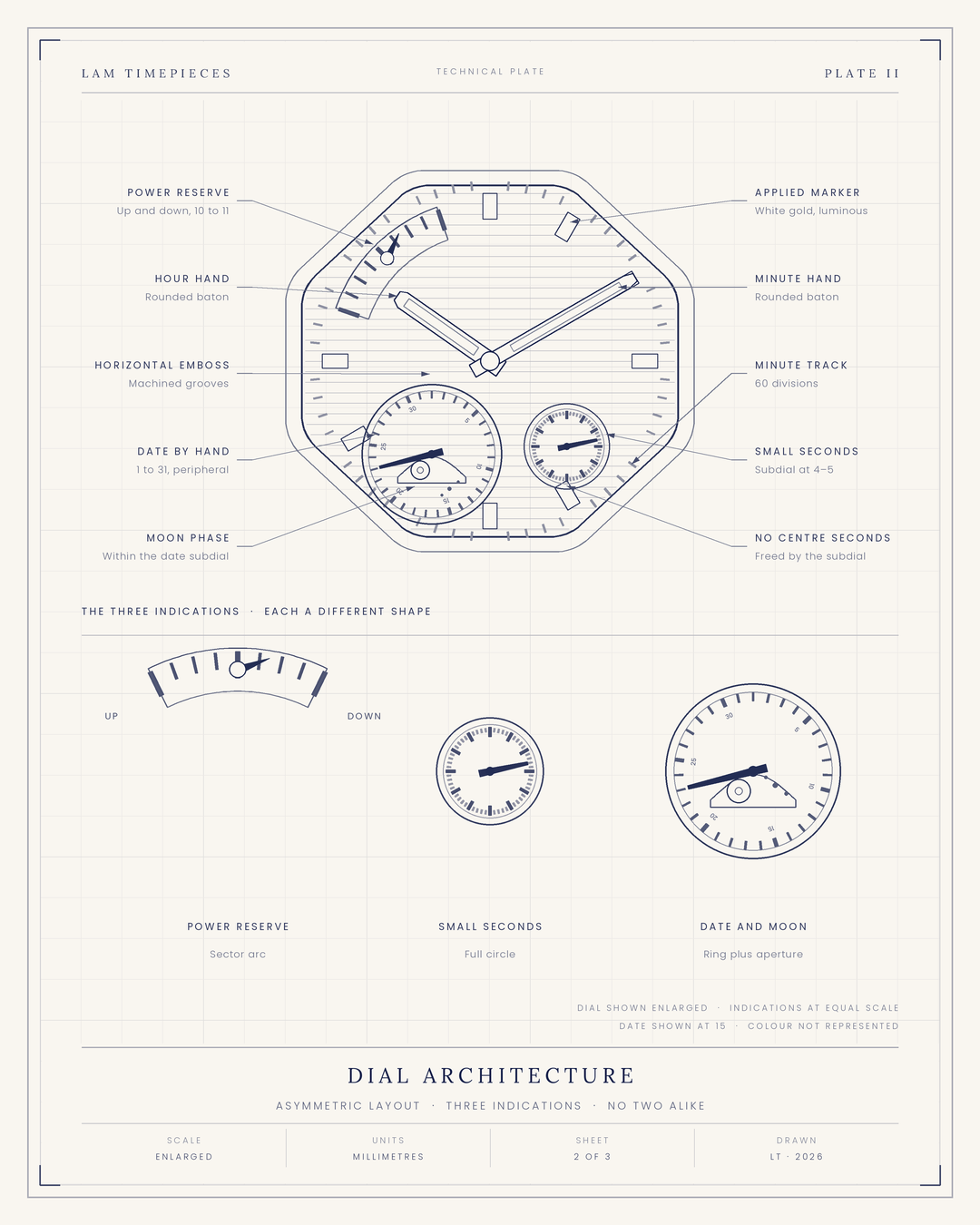
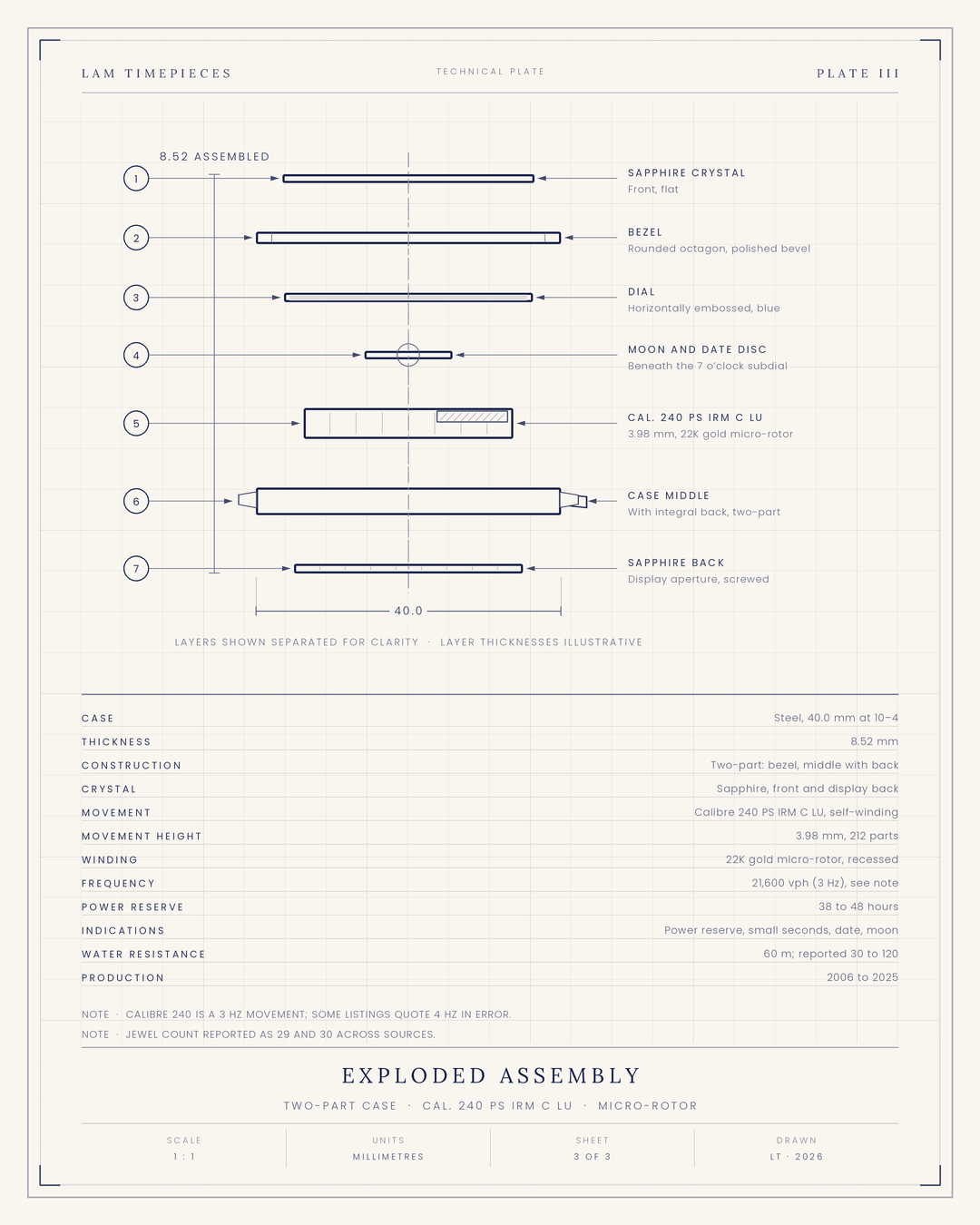
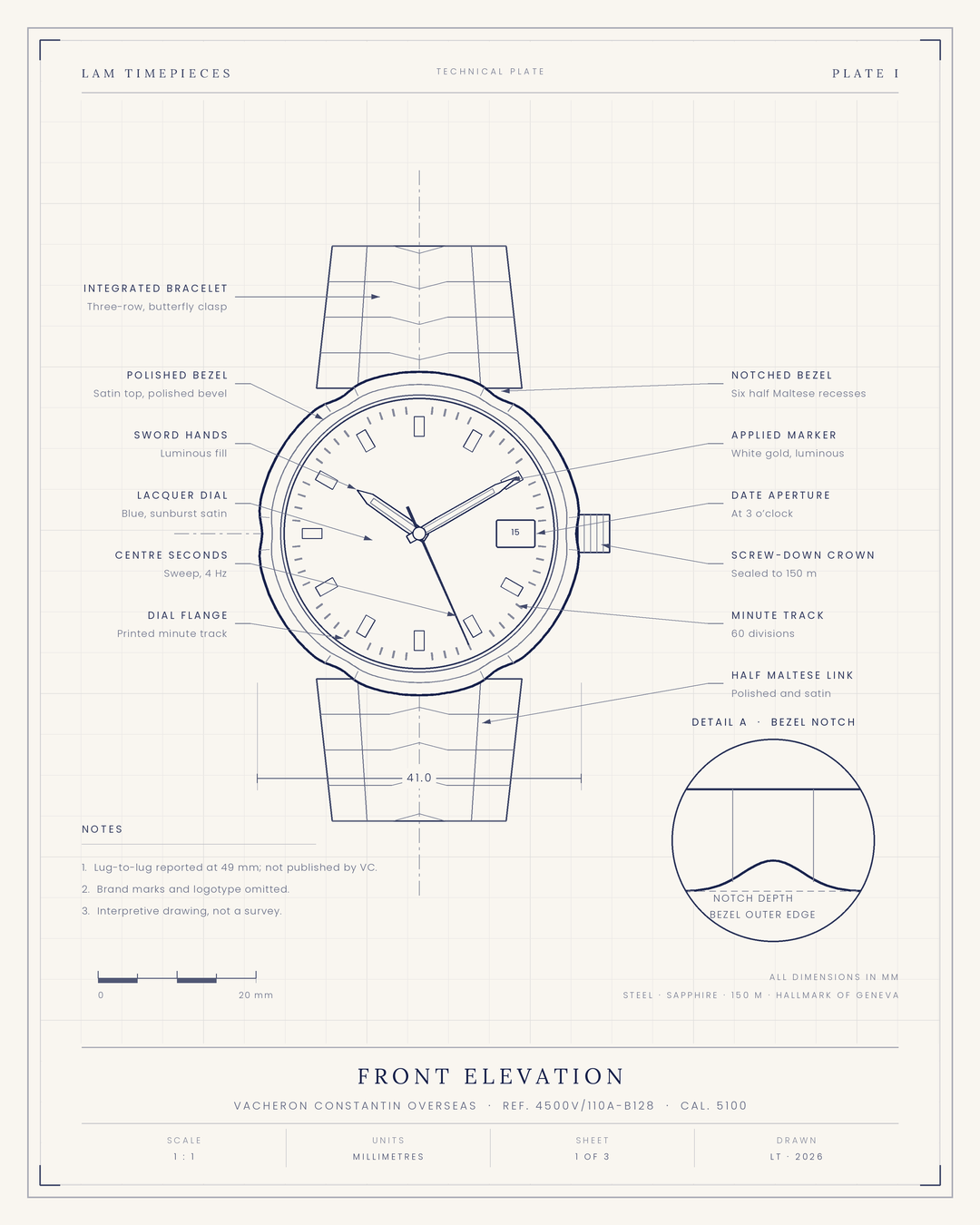
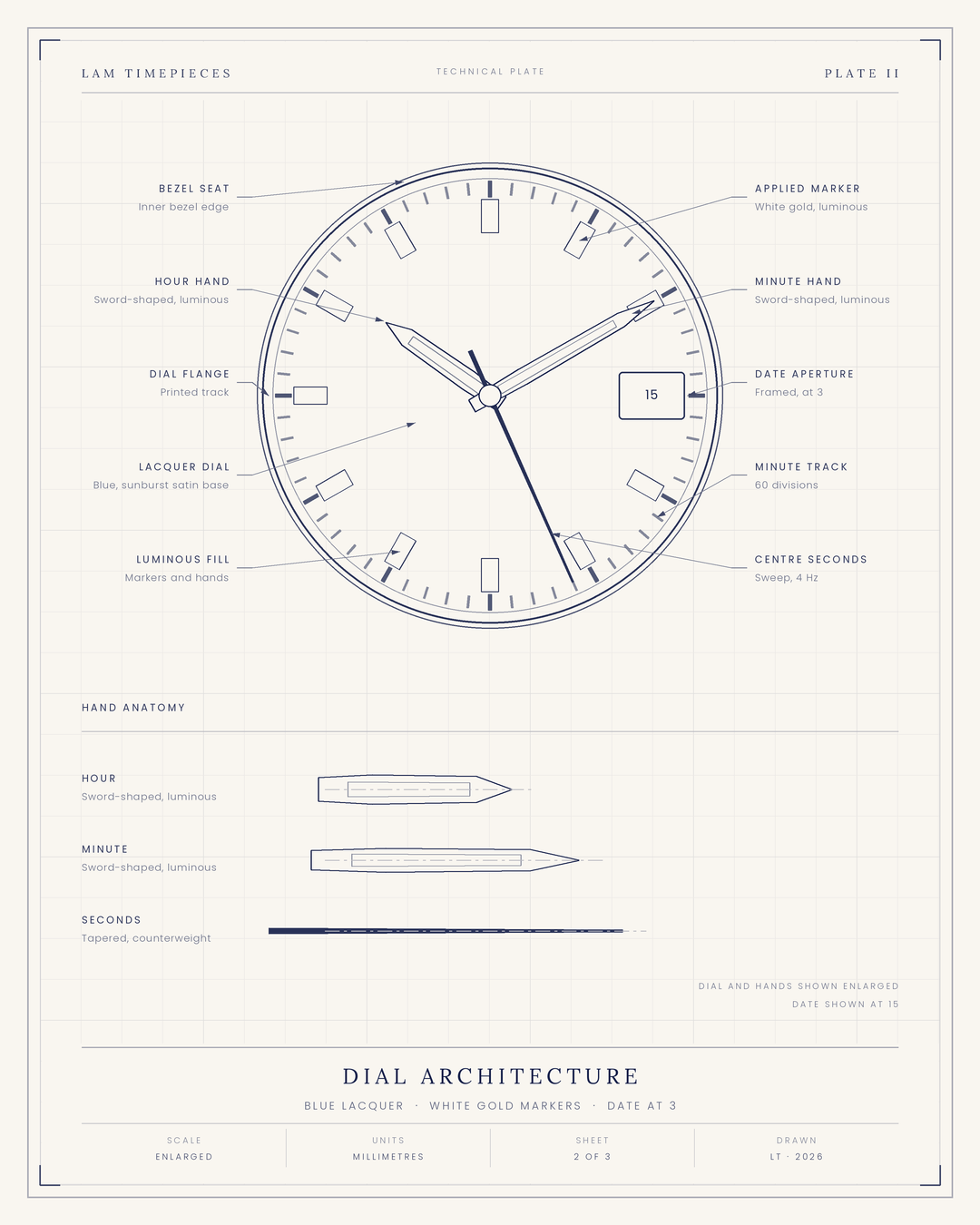
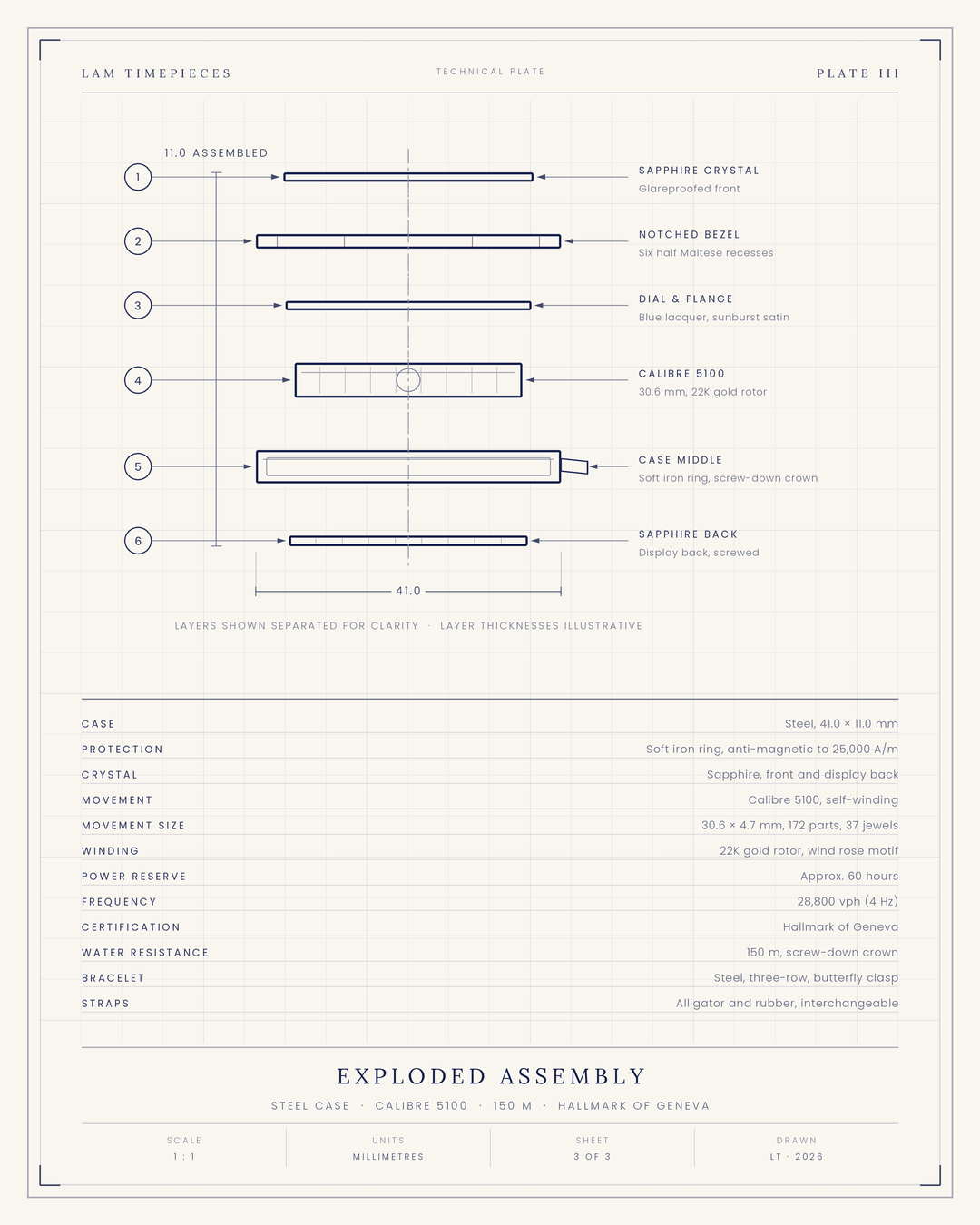
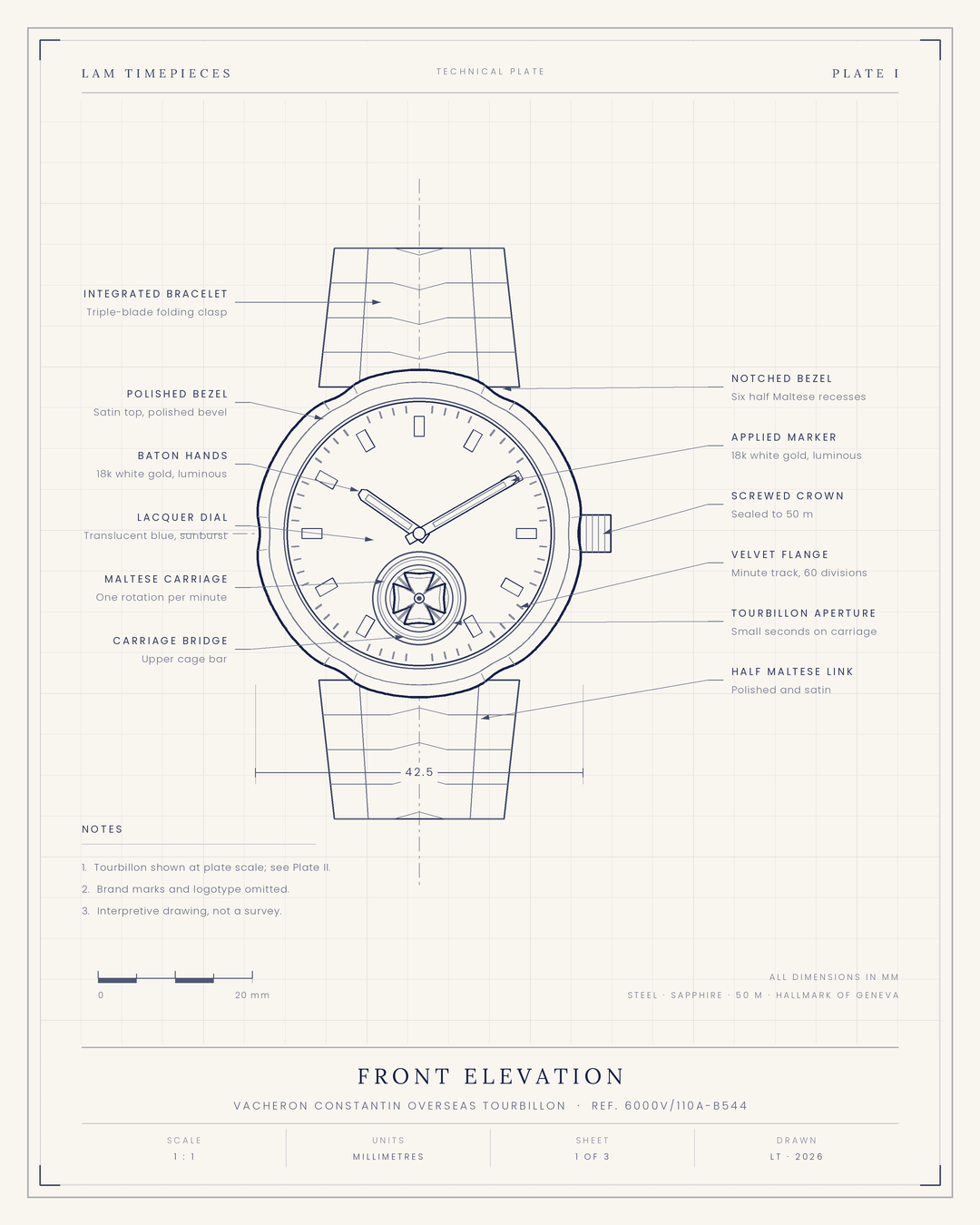
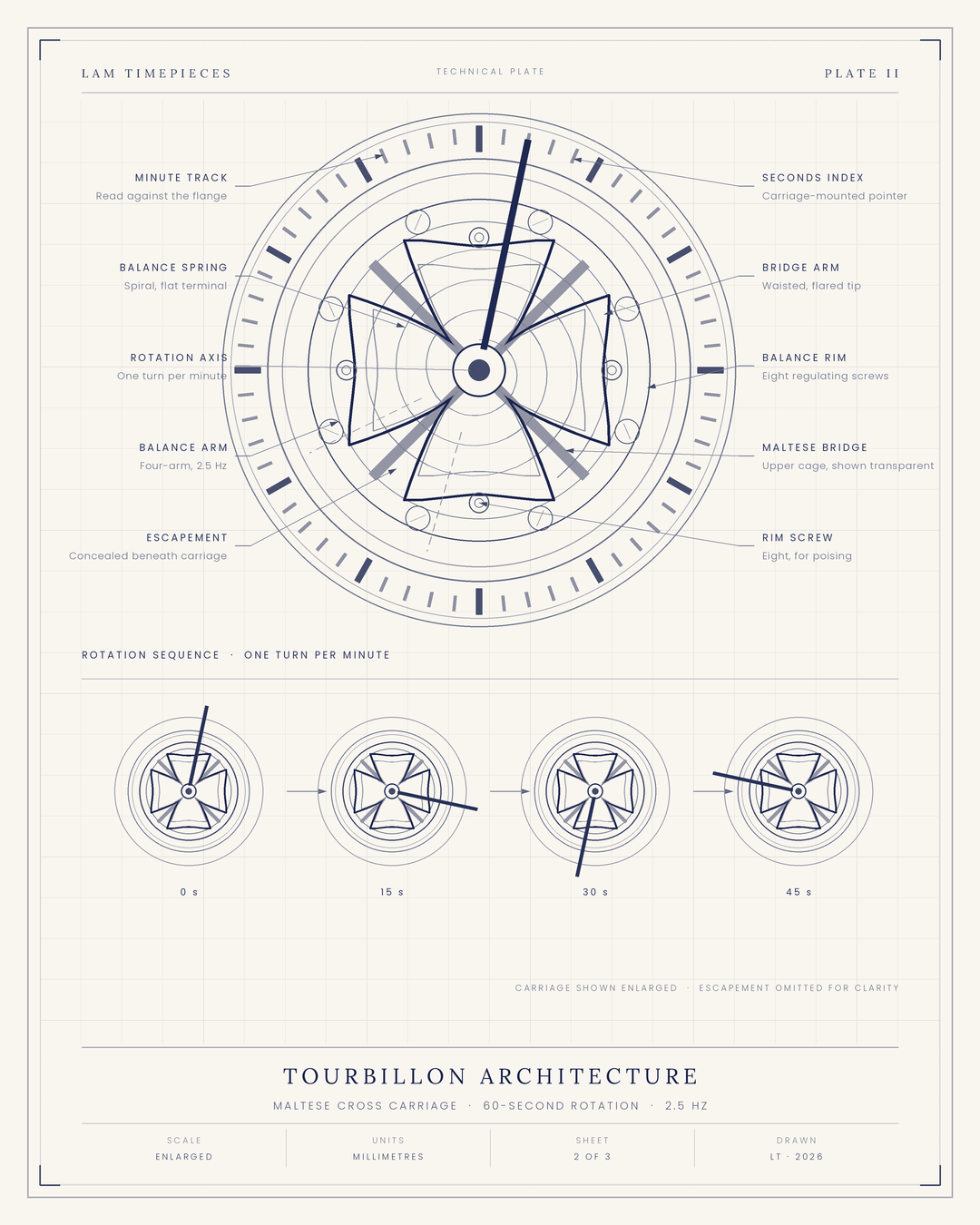
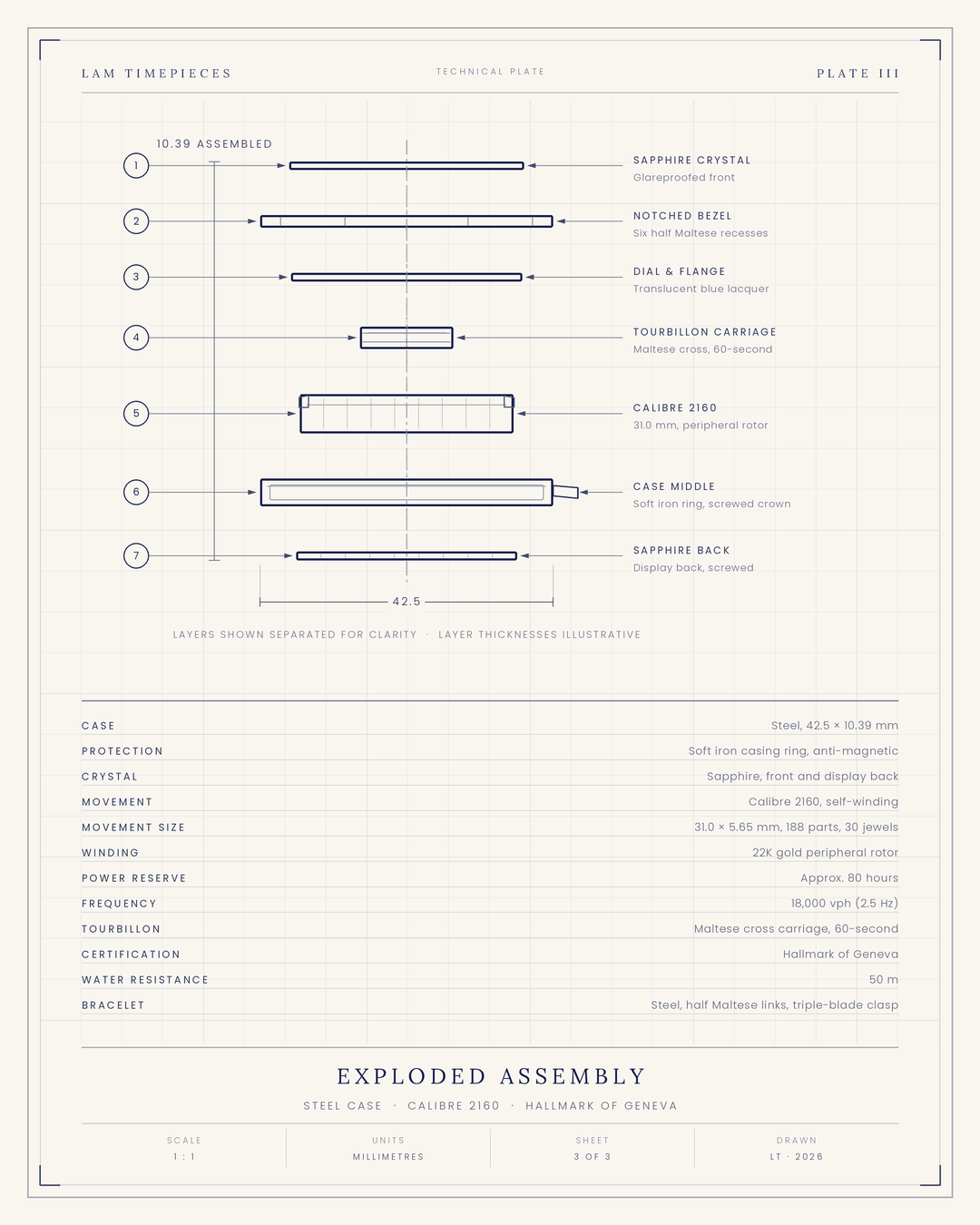
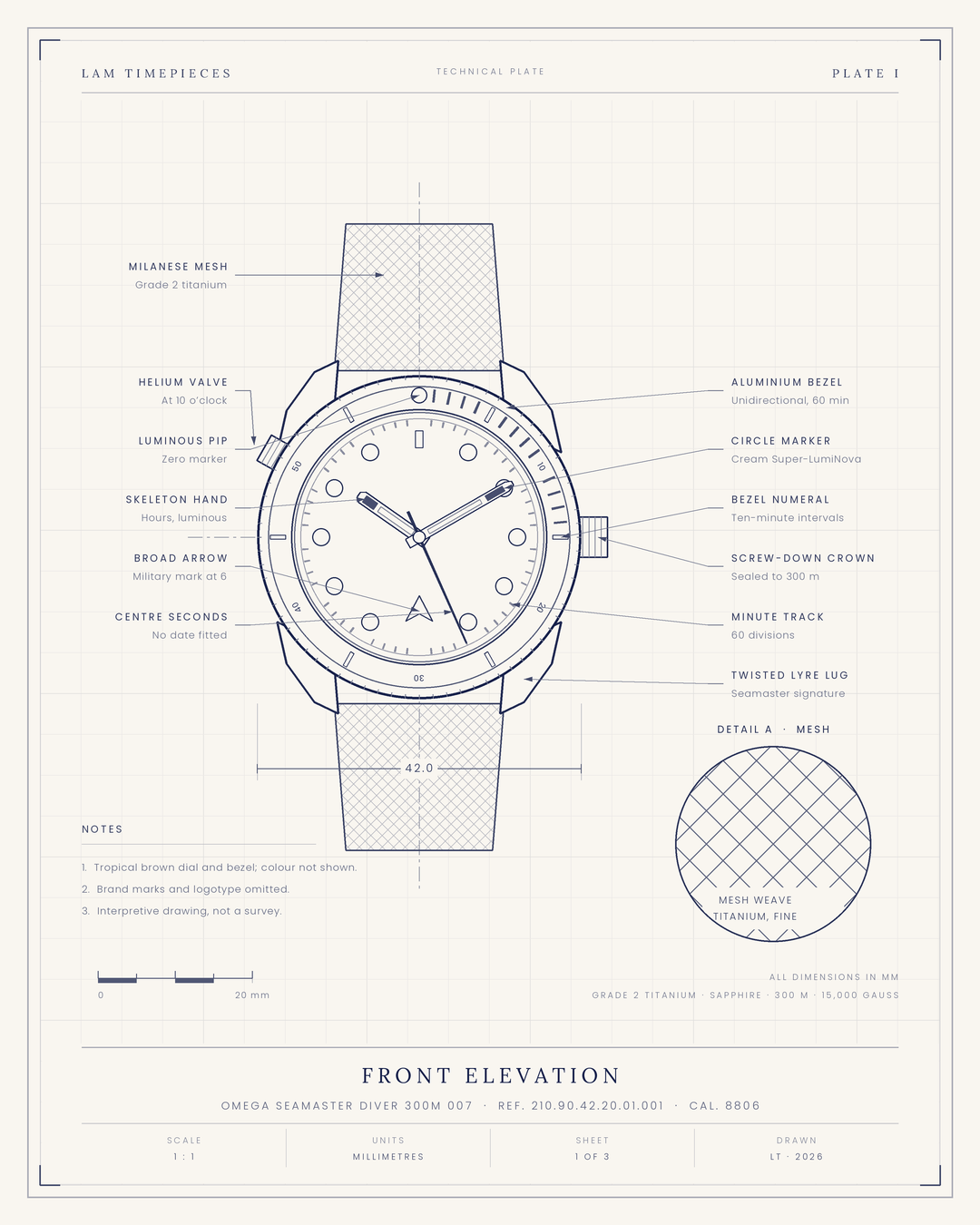
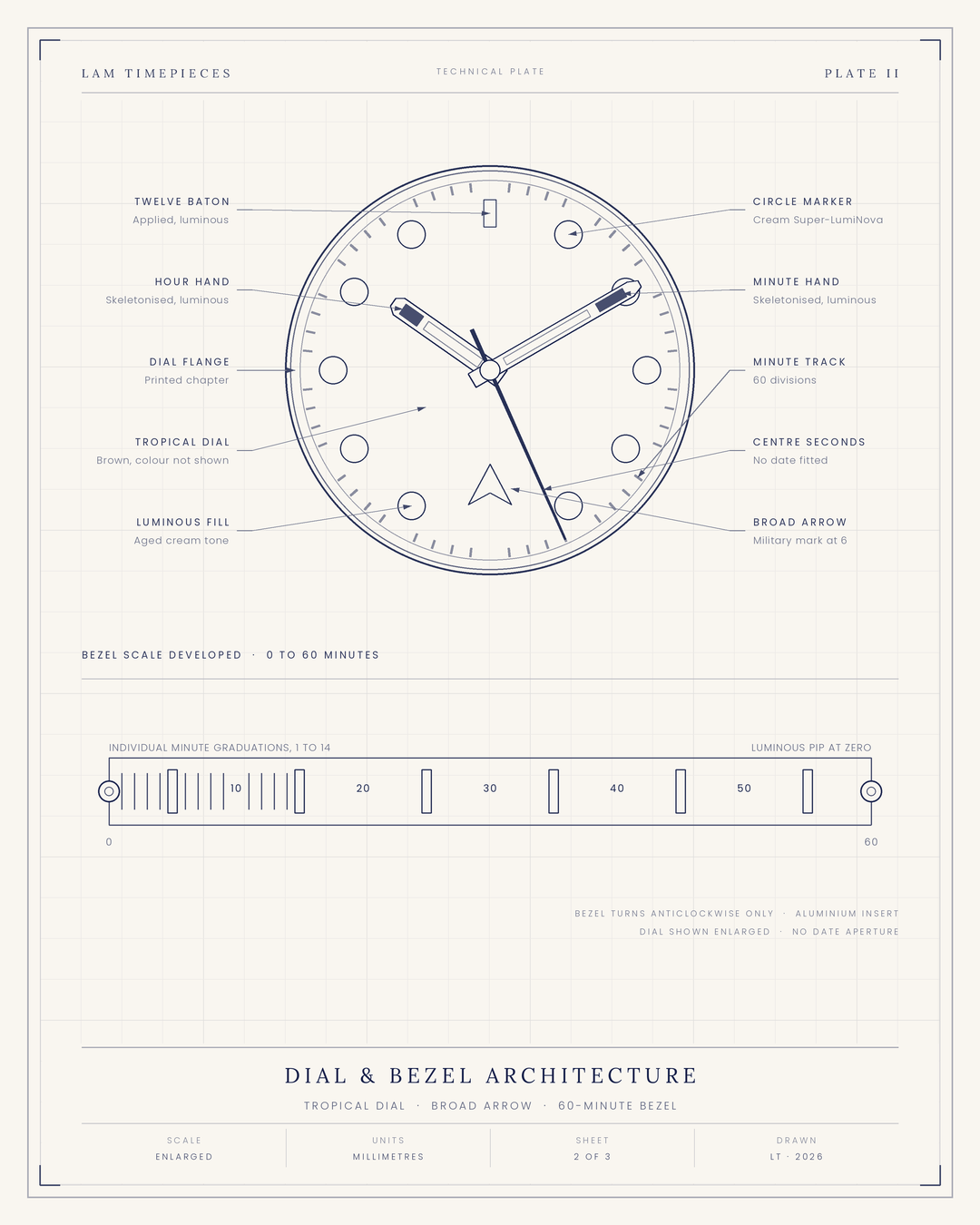
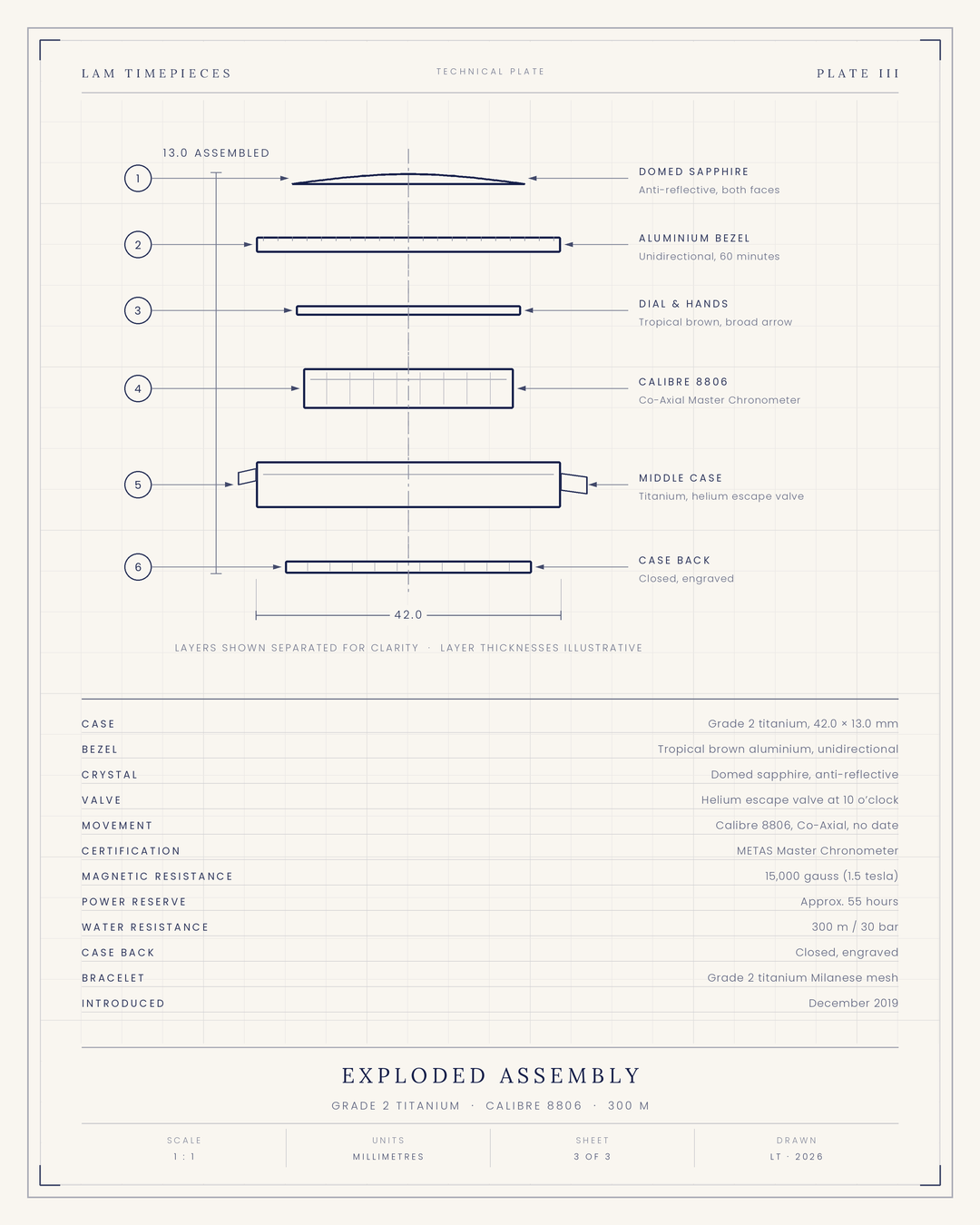
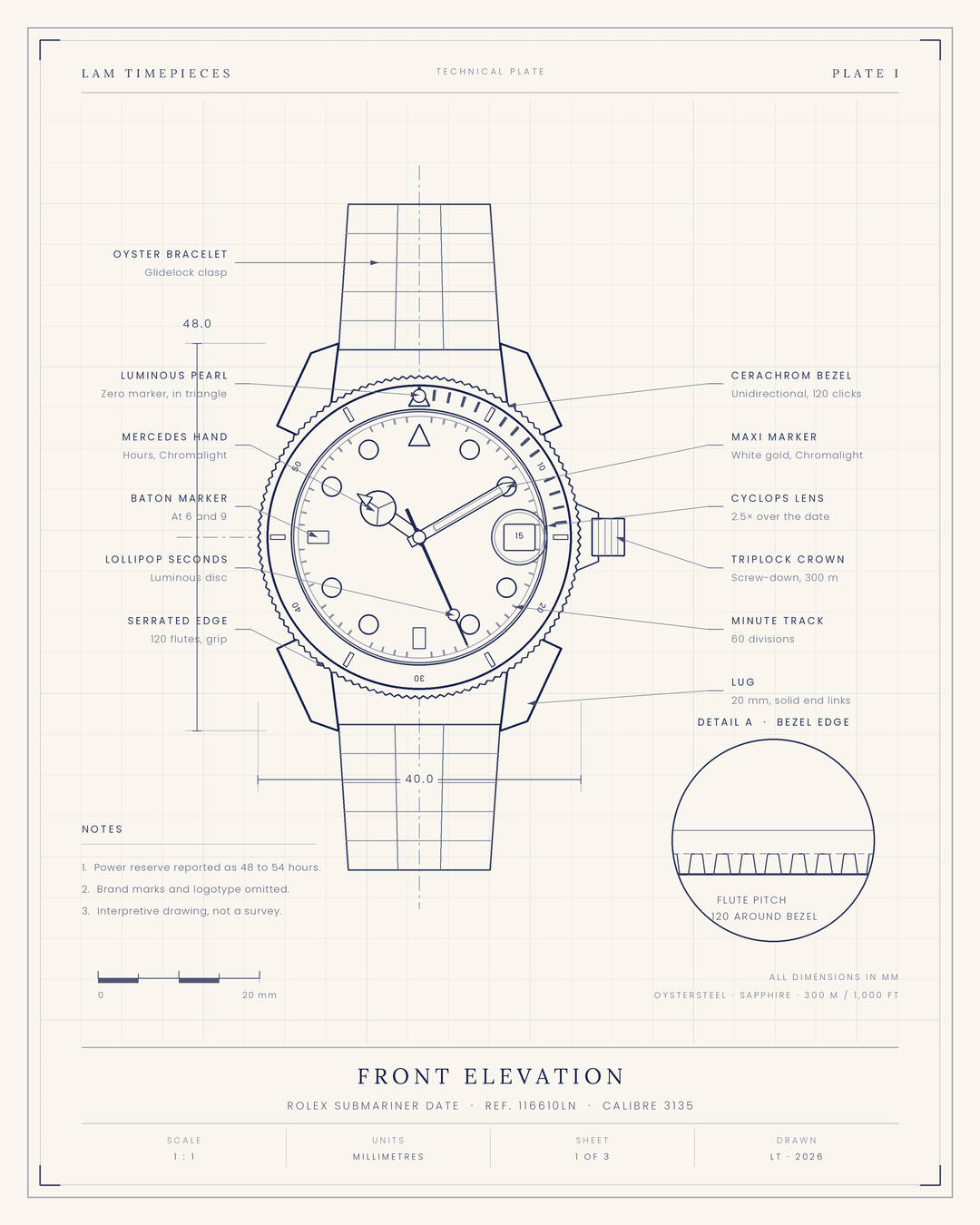
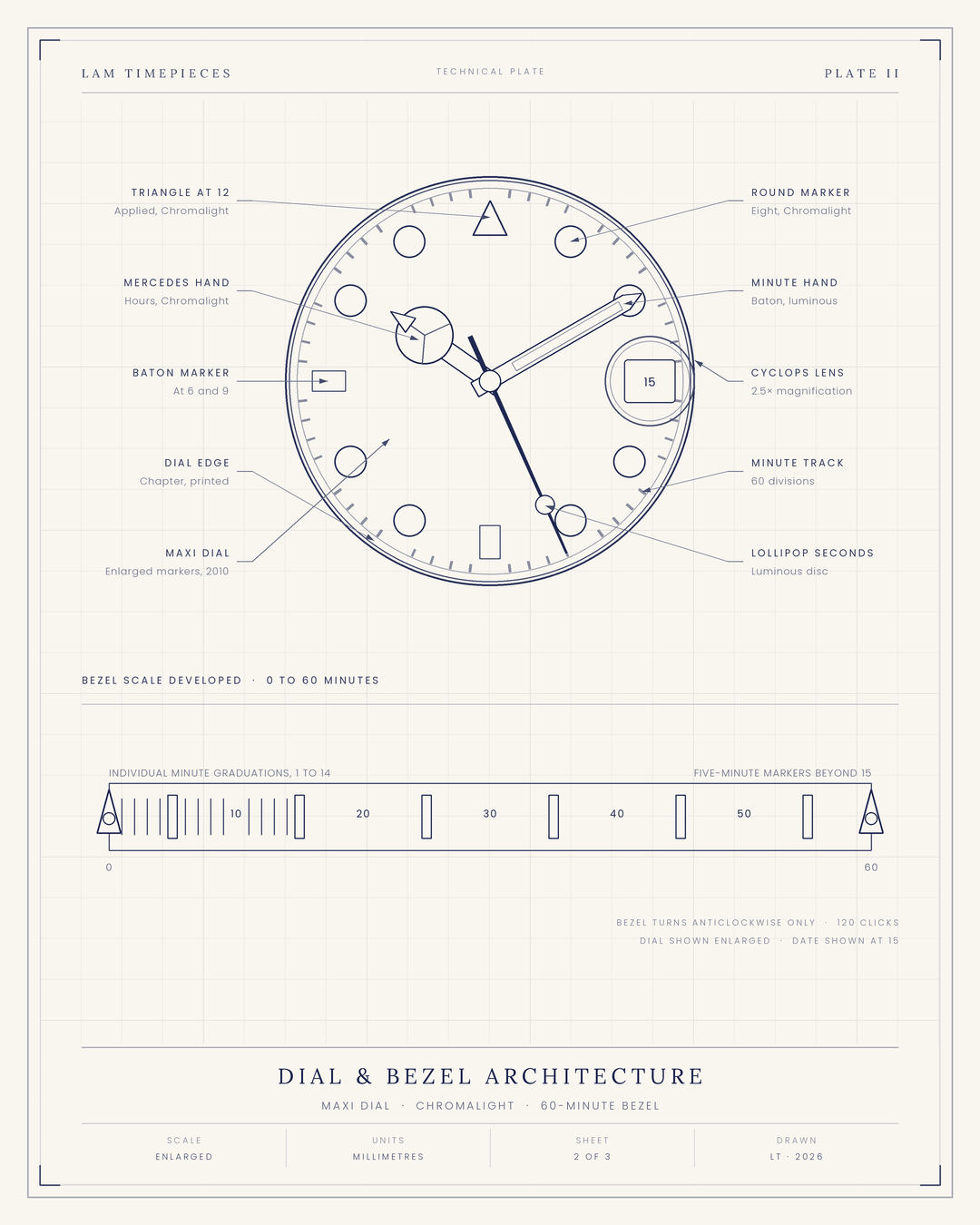
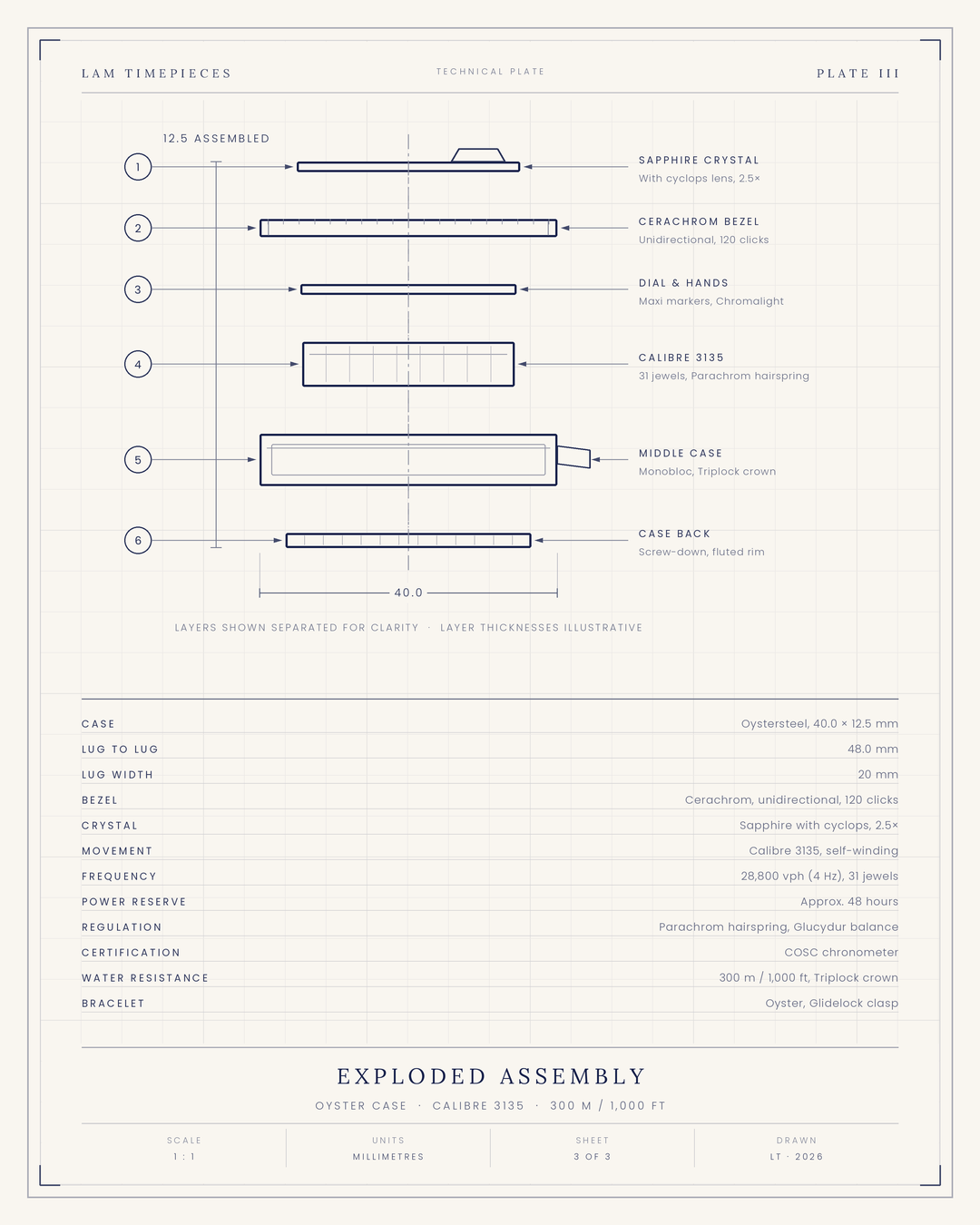
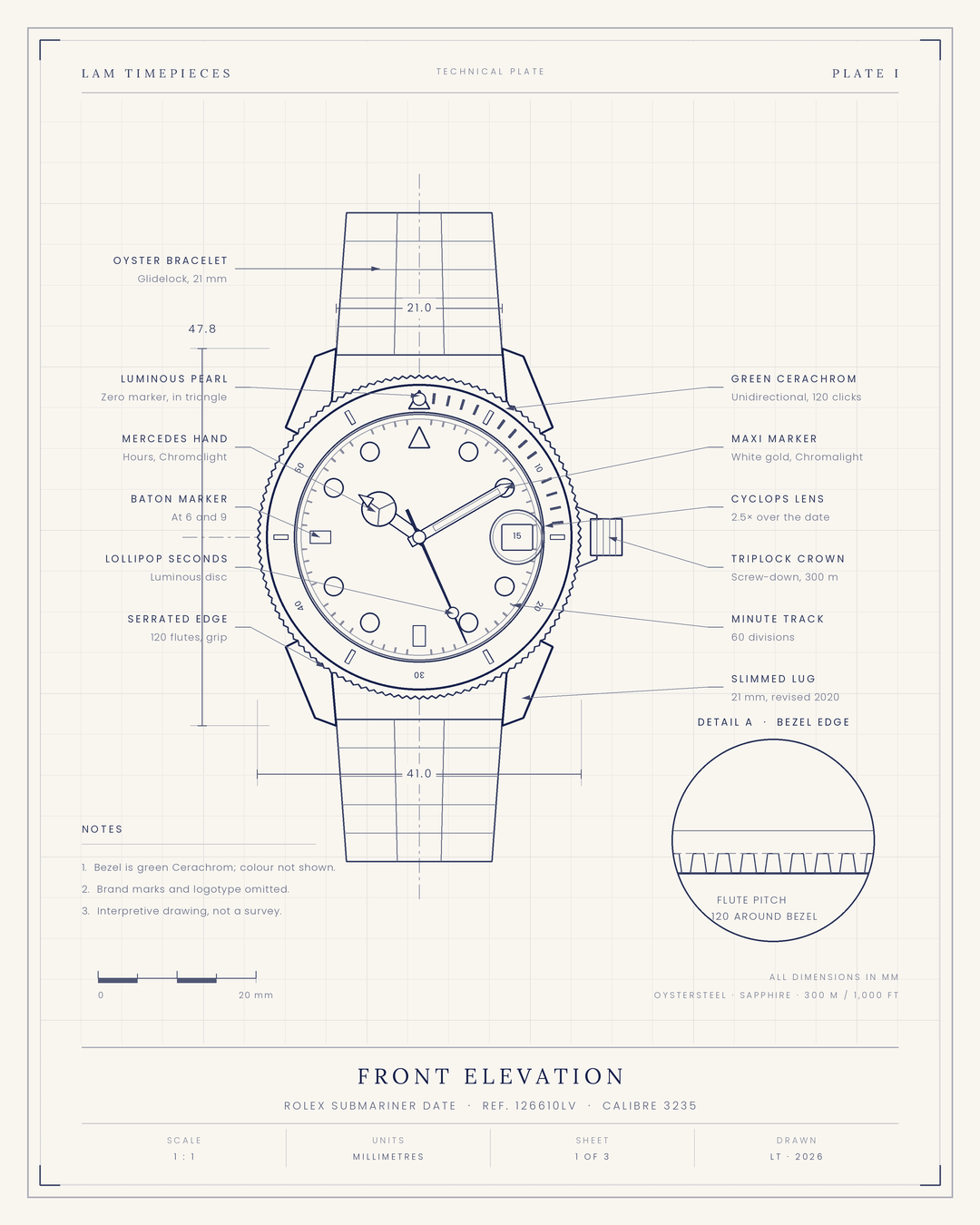
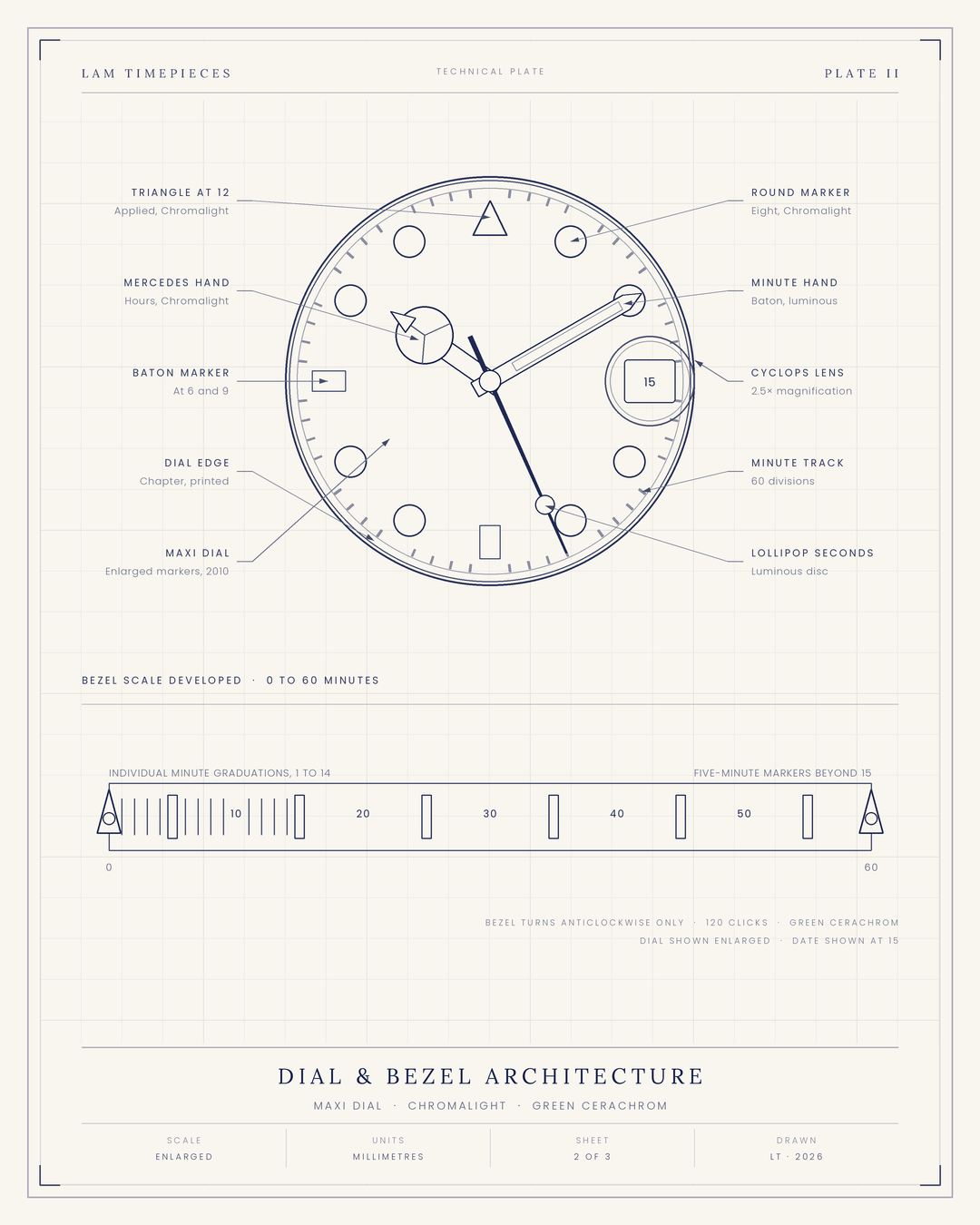
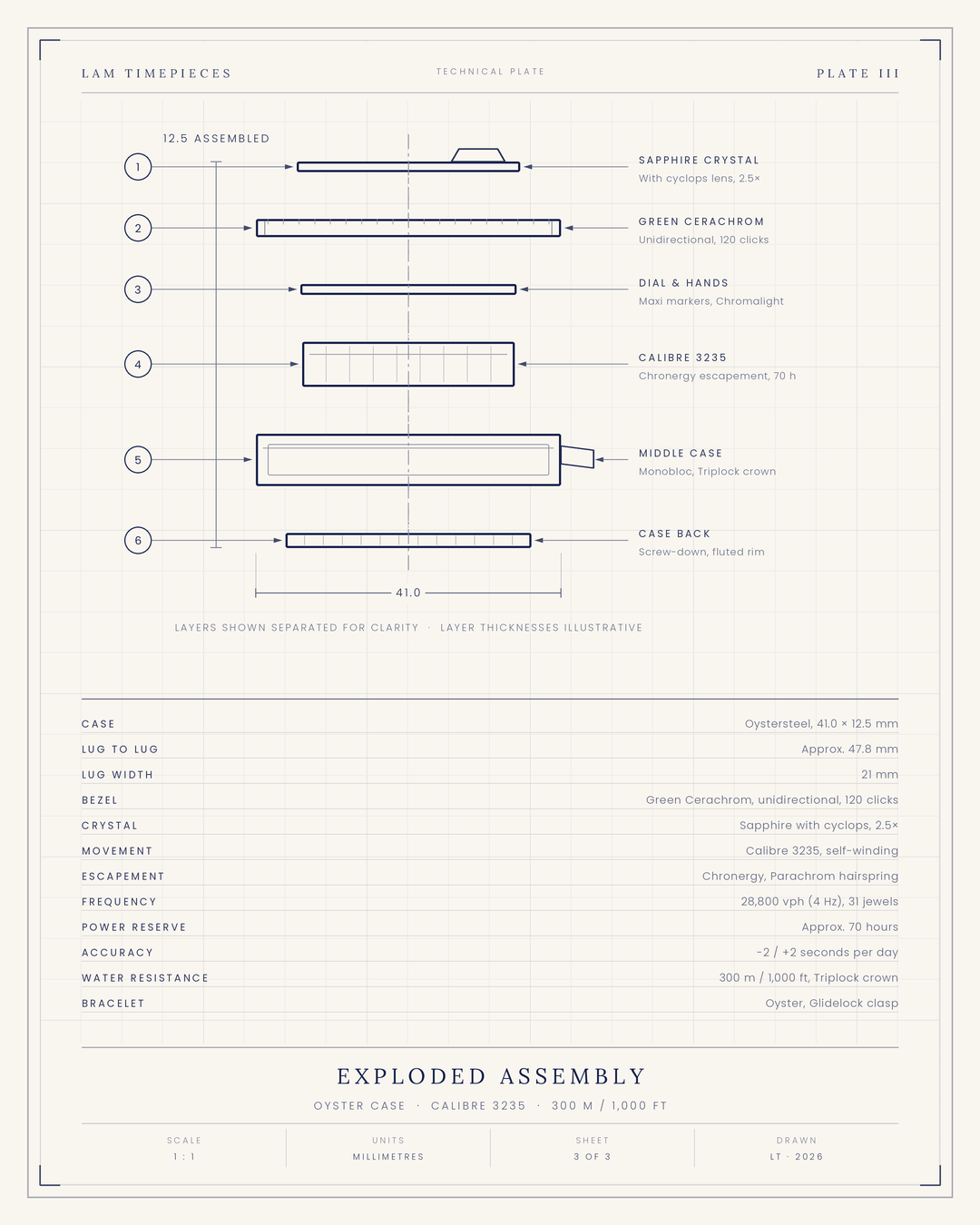
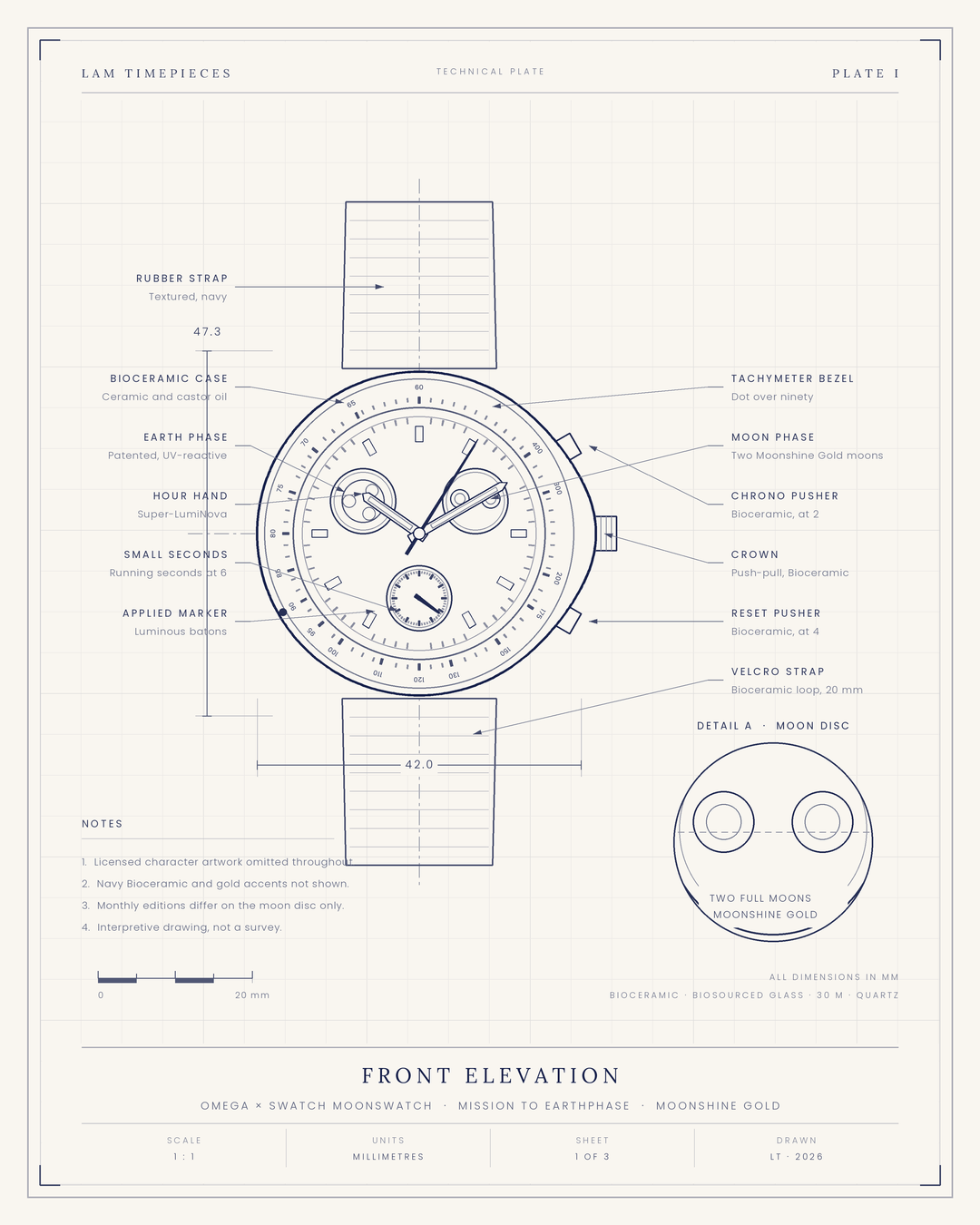
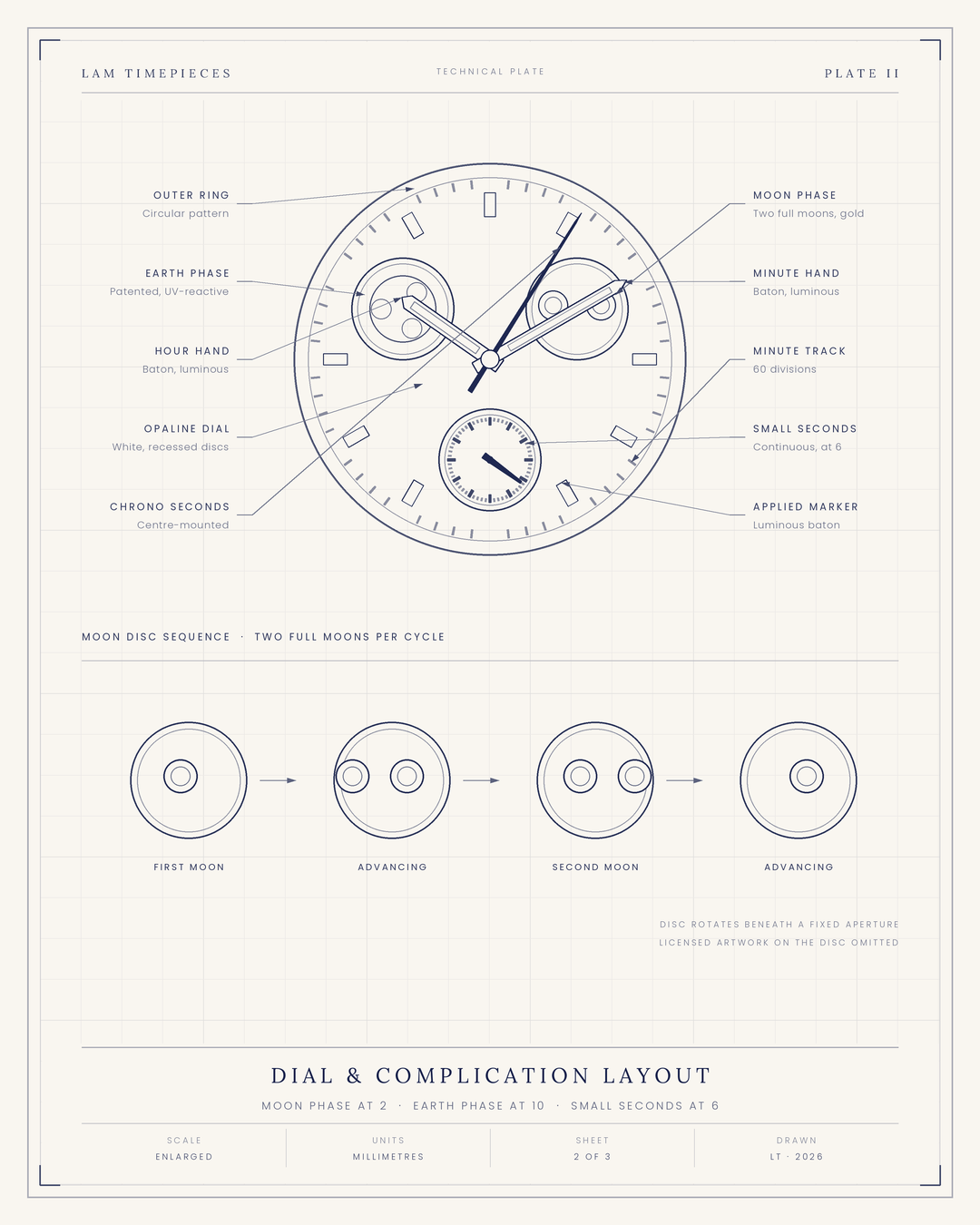
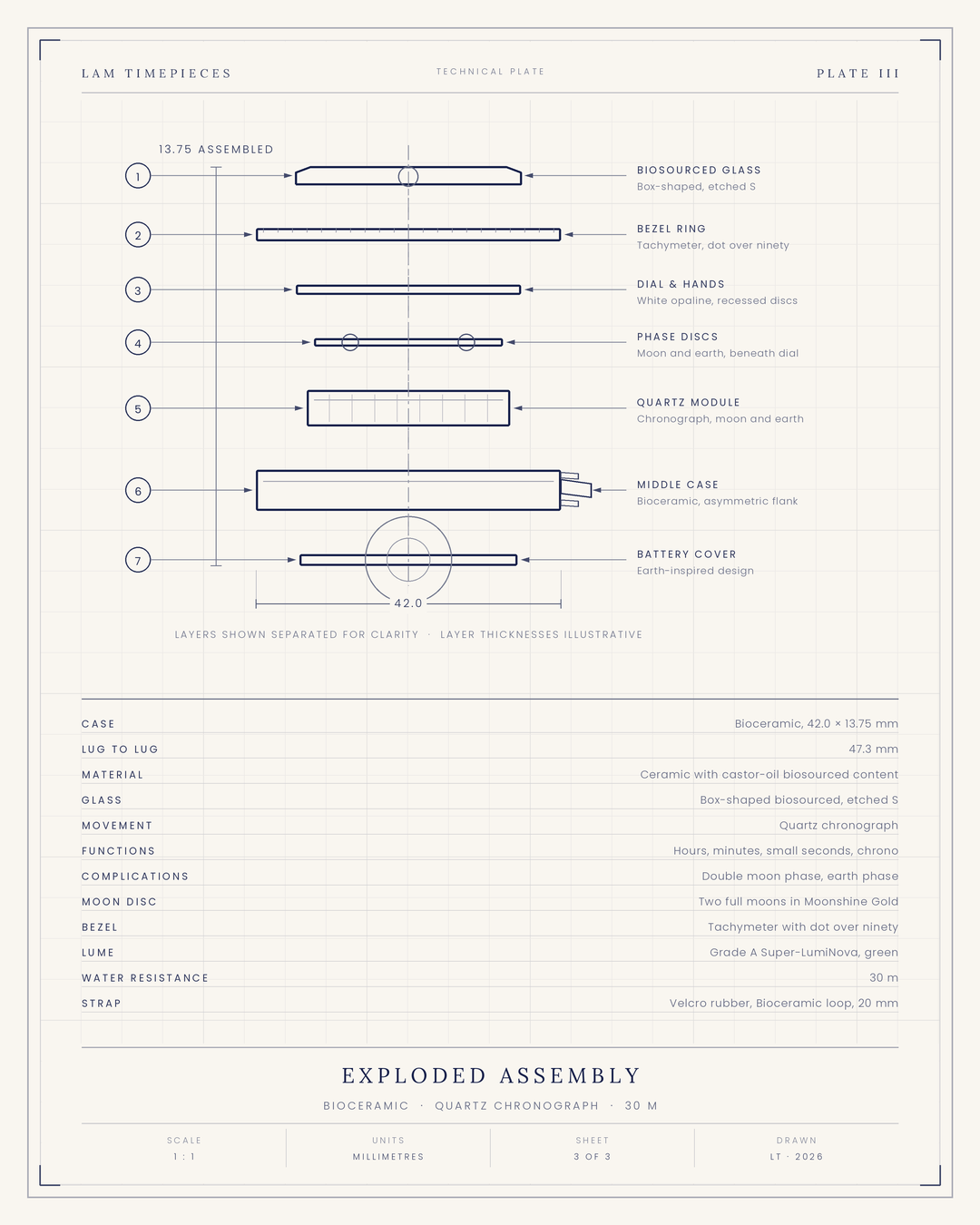
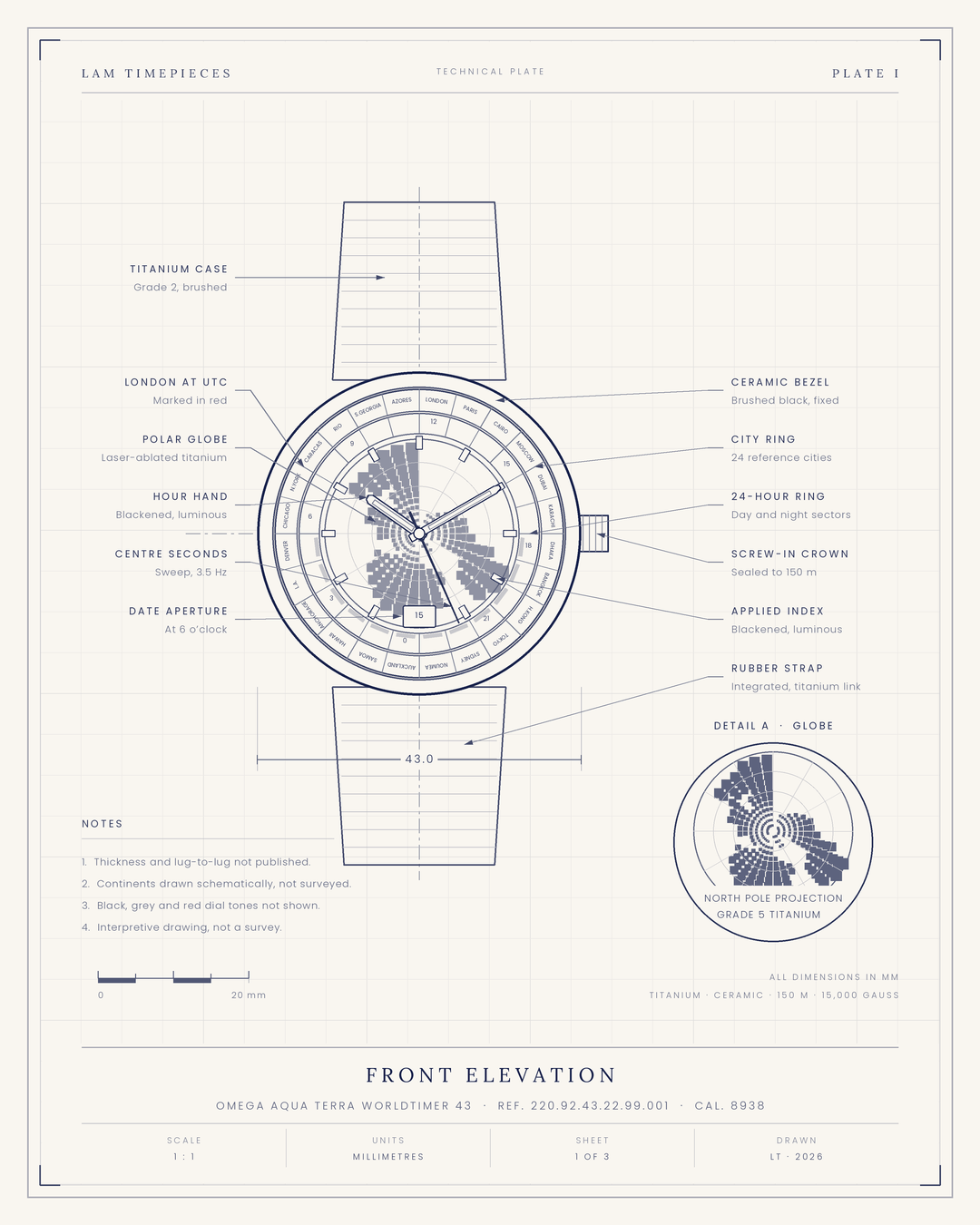
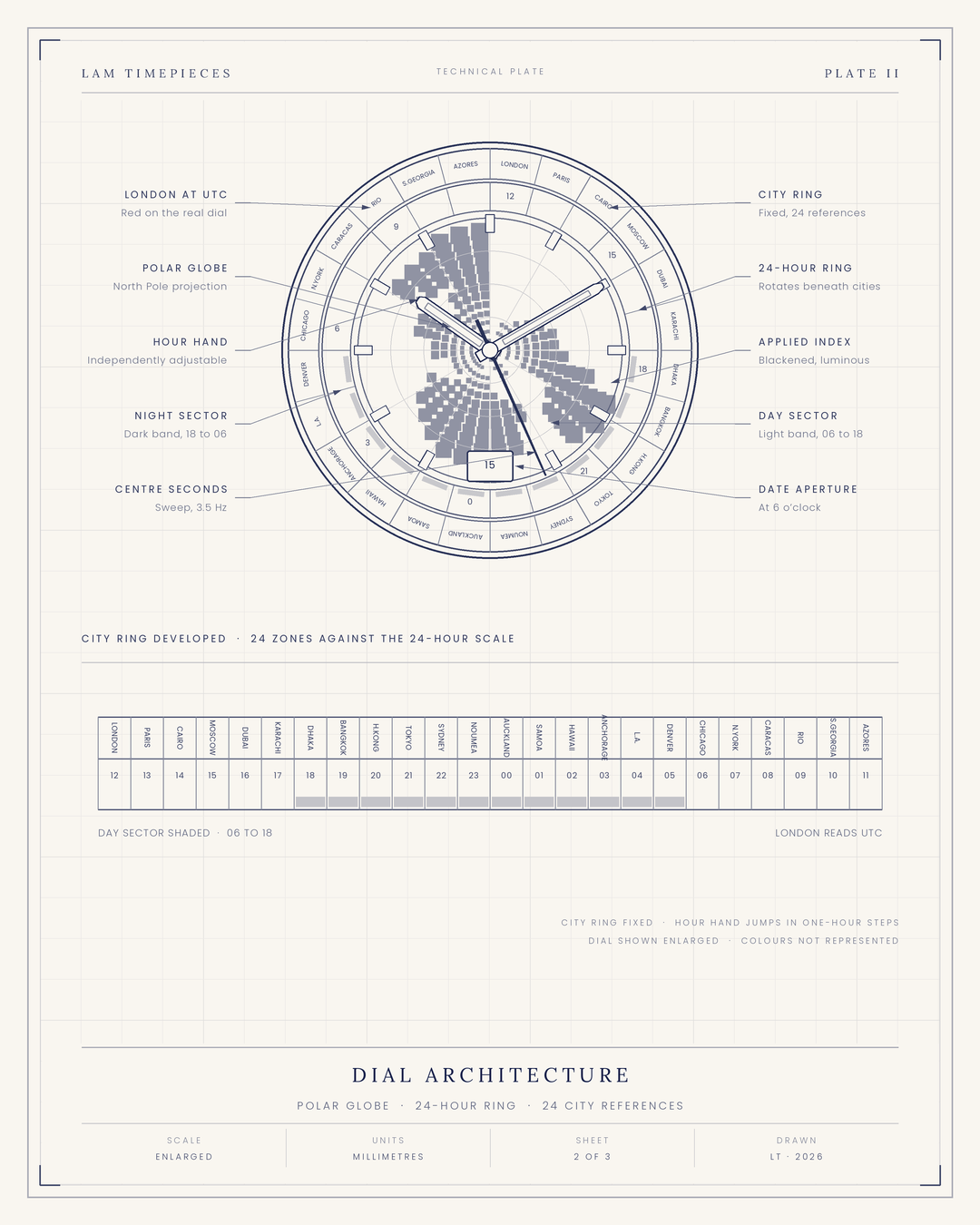
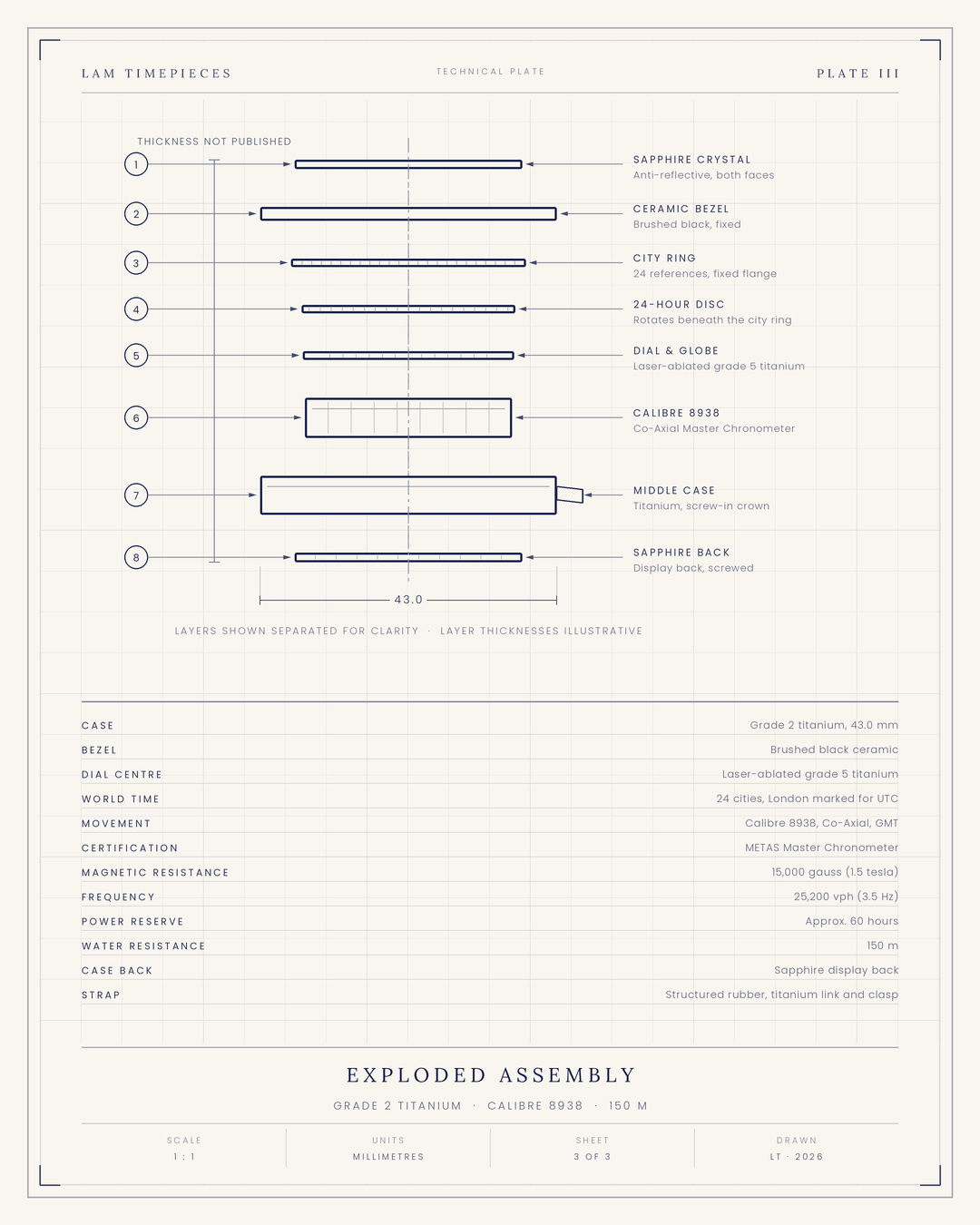
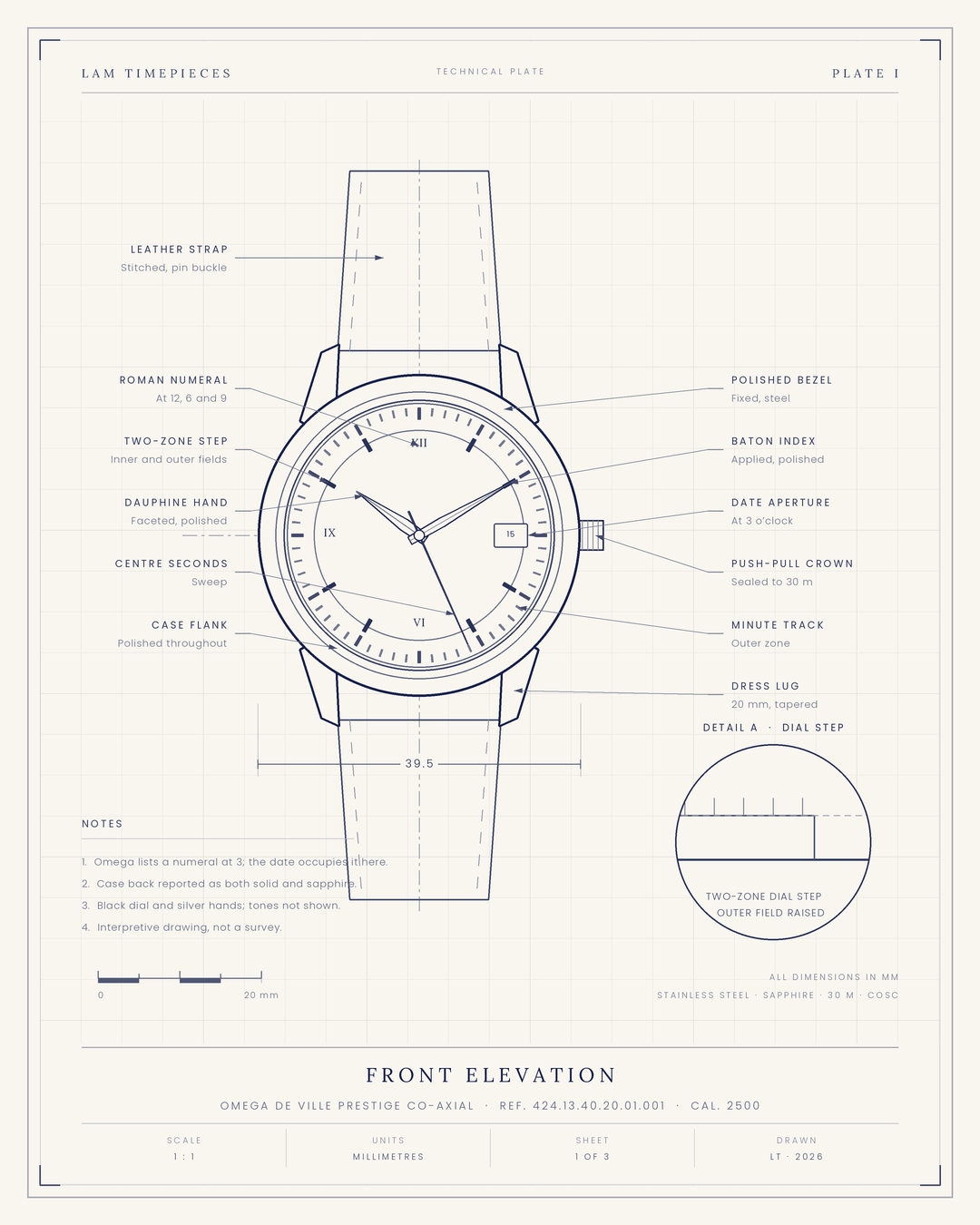
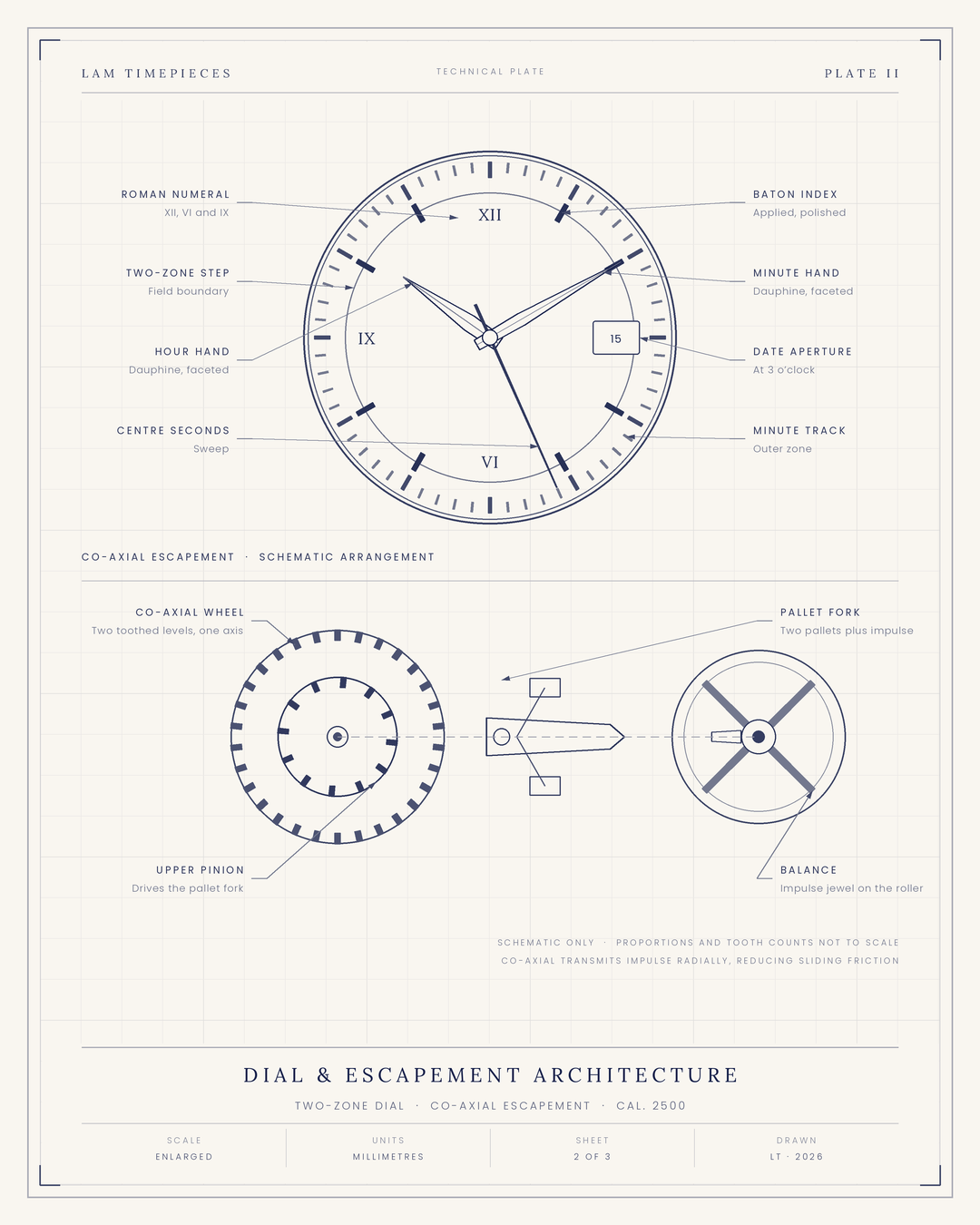
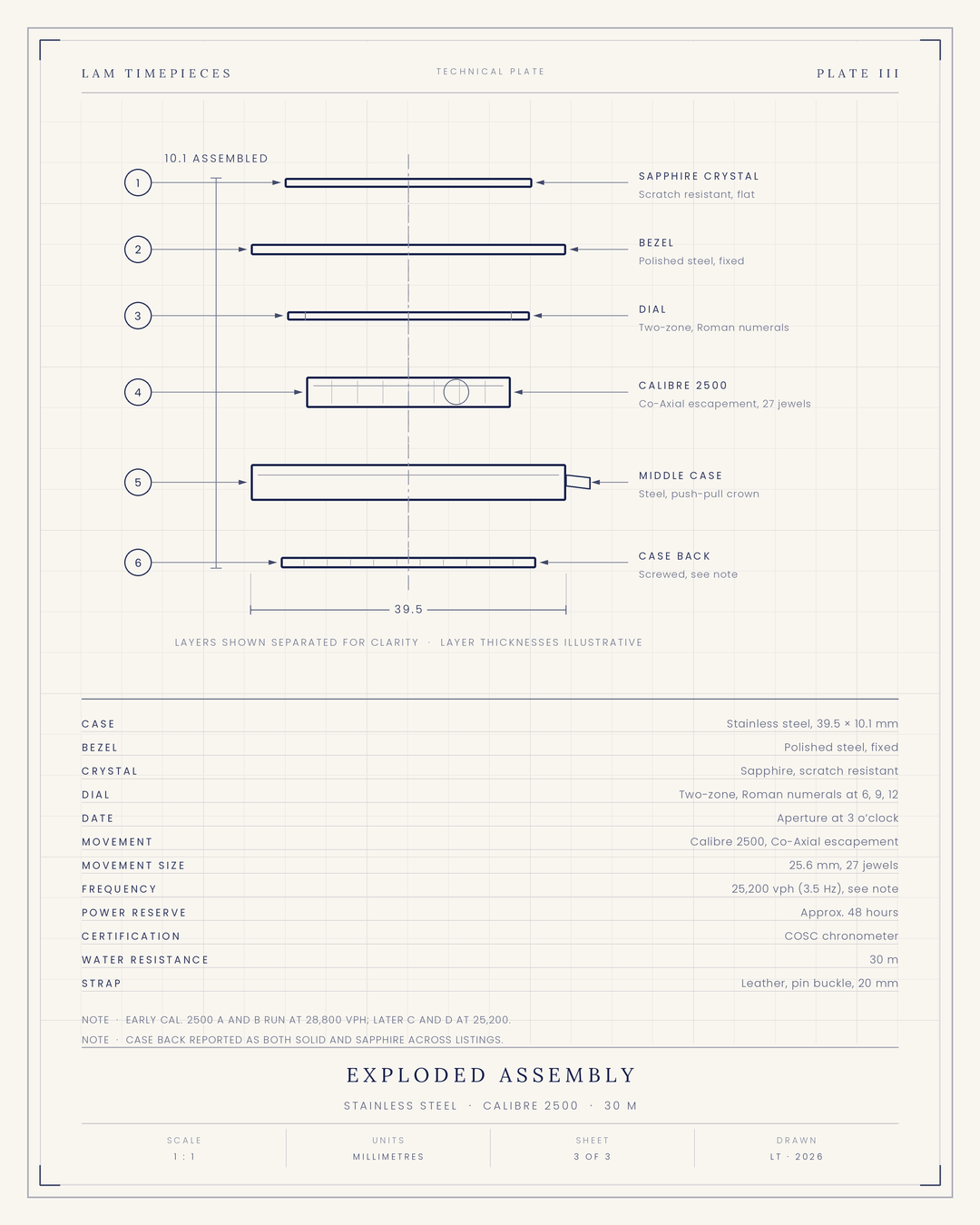
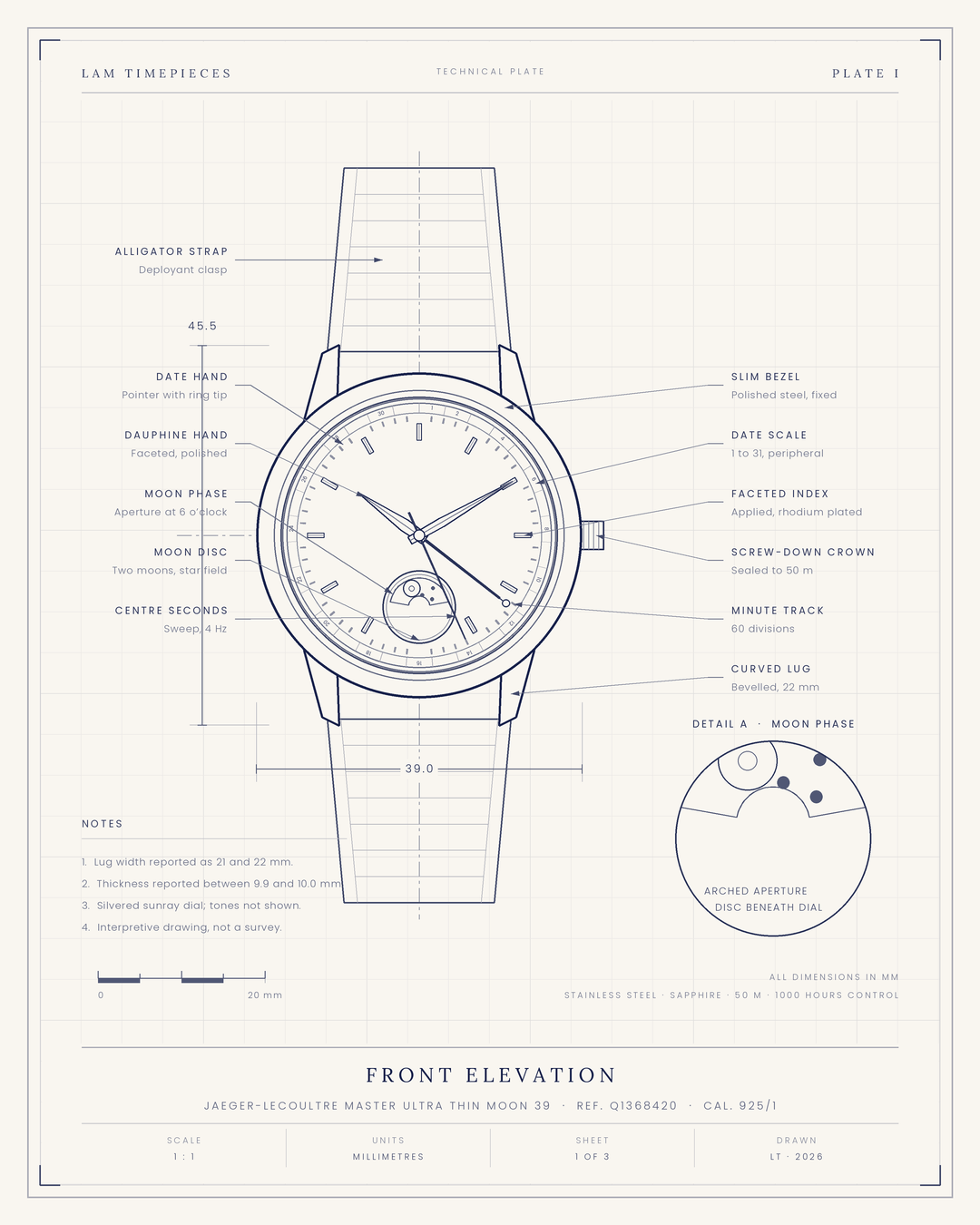
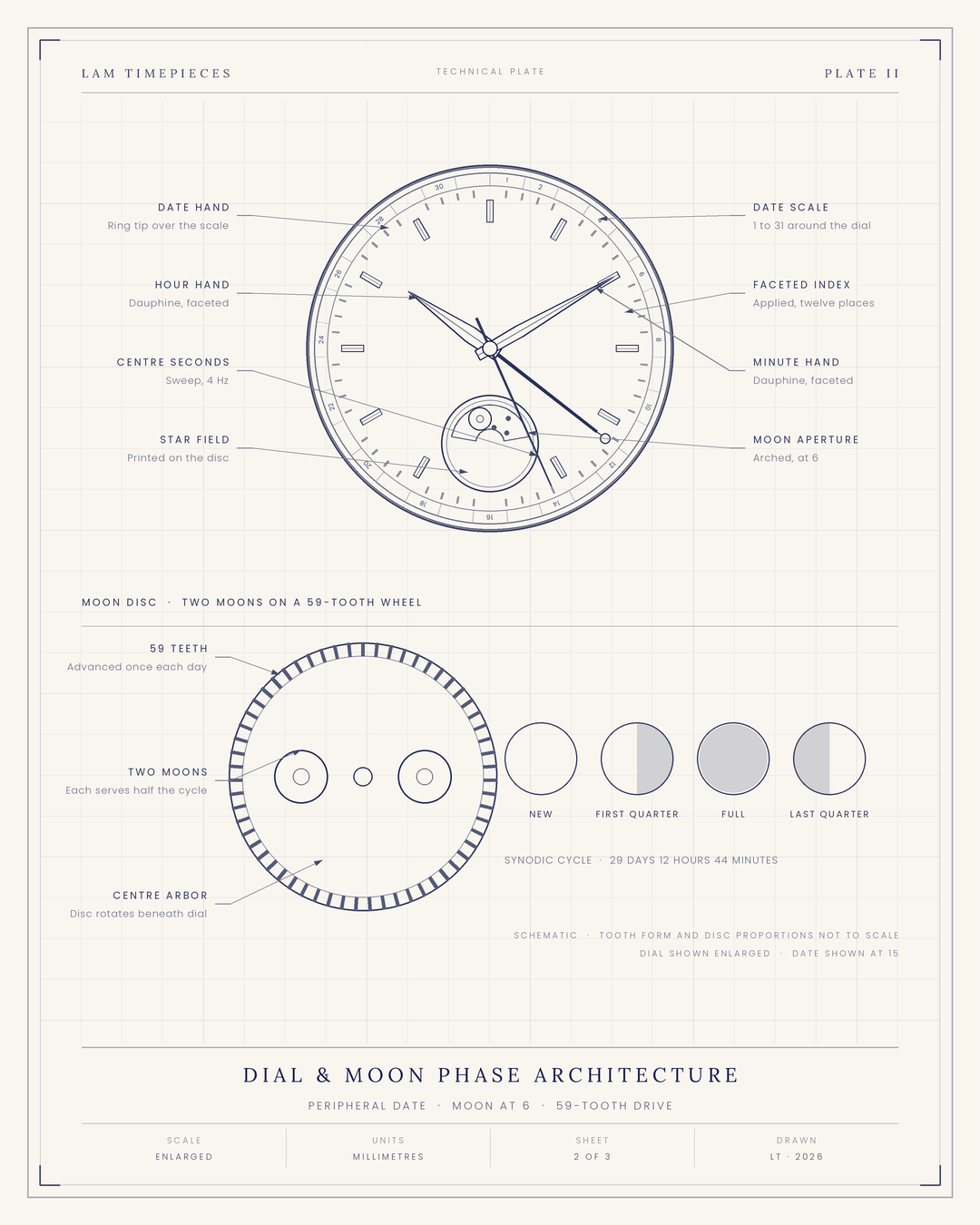
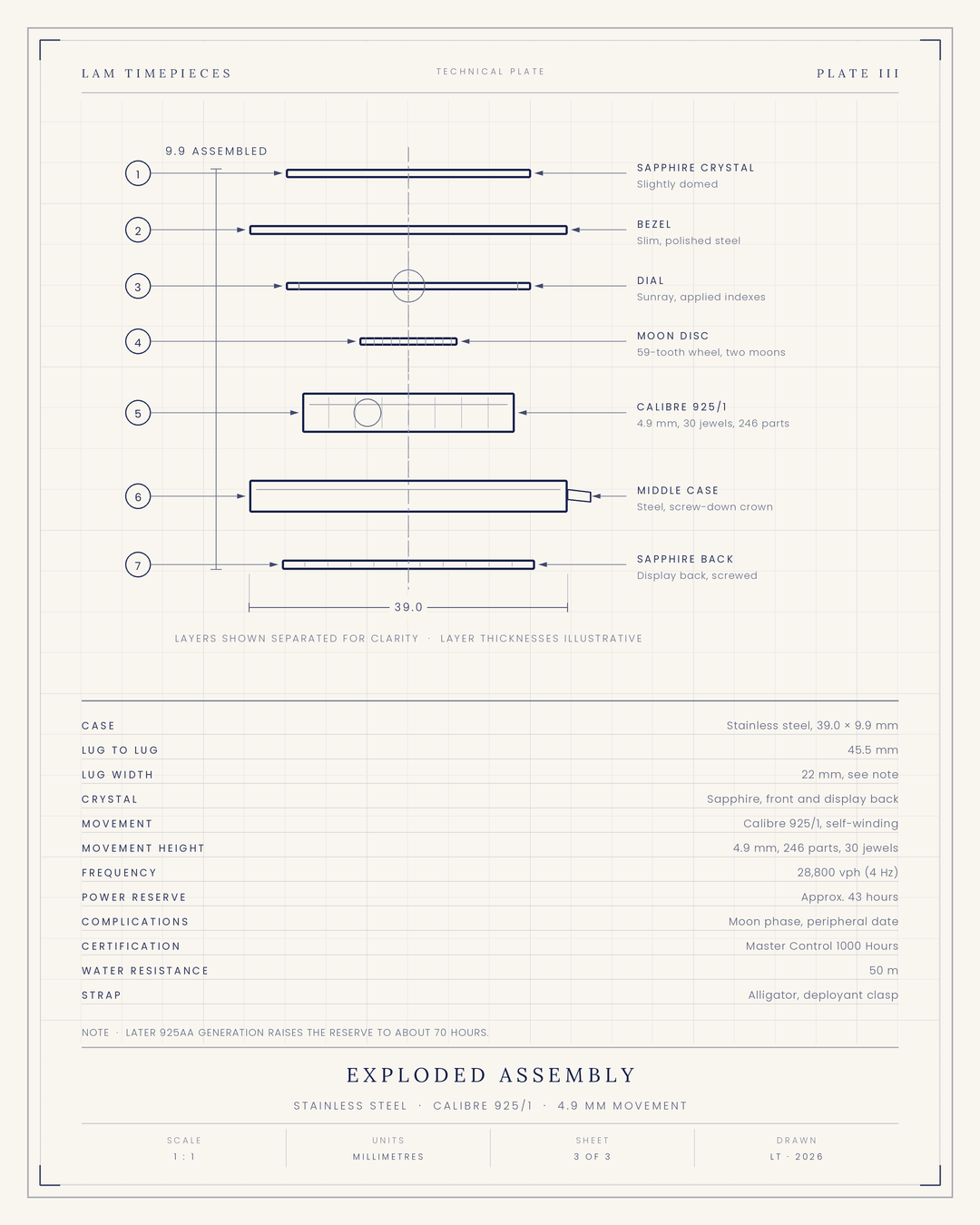
Technical plates I drew myself — front elevations, dial architecture and exploded assemblies for every watch in the collection.
How a mechanical watch actually works.
A mechanical watch contains no battery and no electronics. You push energy into it once, and it releases that energy in pieces so small and so regular that you can measure your life with them. What follows is that single idea taken apart, component by component, in the order the energy travels. Every diagram here is live — the wheels really turn at their correct relative speeds, and four of them you can control yourself.
The movement, in the round.
Drag to turn it over. Scroll or pinch to move closer. Pull the slider to take it apart layer by layer, in the order a watchmaker actually assembles it.
Your browser cannot display the 3D movement. Everything it shows is explained in the diagrams below.
Mainplate · barrel · centre, third and fourth wheels · escape wheel · pallet fork · balance and hairspring · bridges. Every wheel turns at its true relative speed — the fourth wheel once a minute, the balance at four swings a second.
If you have never taken one apart, start here: a mechanical watch is a machine with exactly one input and one output. The input is you, turning a knob. The output is a hand moving at a rate you can trust. Everything between those two points exists to slow the input down and make it regular — and there are only five stages worth remembering.
Storing a day of energy in a ribbon of steel.
Start with the barrel. It is a shallow toothed drum about the size of a shirt button, and inside it lives a ribbon of hardened steel roughly 40 centimetres long and a tenth of a millimetre thick — thinner than a fingernail. One end is fixed to a post at the centre, the other hooks onto the barrel wall.
Turning the crown rotates that arbor, drawing the ribbon into a tighter spiral. Because the steel is elastic, bending it stores energy: the metal resists deformation, and the work you do winding it is held as elastic potential energy in the material itself. Release the arbor and the spring unwinds, turning the barrel and driving everything downstream. That is the watch’s entire power supply.
The numbers involved are strikingly small. A fully wound mainspring in a wristwatch holds somewhere around a joule of energy — roughly what it takes to lift an apple off a table by ten centimetres. That single joule has to run the watch for two days. Spread across 40 hours, the average power output is well under a ten-thousandth of a watt, which is why every source of friction downstream matters so much: there is almost nothing to spare.
The spring is also not simple steel any more. Traditional carbon steel springs took a permanent set over time, gradually losing force, which is why old watches ran down faster as the decades passed. Modern springs are cobalt alloys — Nivaflex and its relatives — that are effectively immune to set, non-magnetic, and corrosion resistant. It is one of the quiet reasons a watch made today will still deliver its rated reserve in thirty years.
Watch the coils bunch toward the arbor as you wind. The barrel makes only six or seven full turns across an entire run — about one turn every six hours, making it by far the slowest wheel in the watch.
There is a complication built into this arrangement. A coiled spring does not deliver constant force: it pushes hardest when fully wound and progressively weaker as it unwinds, following a curve rather than a straight line. Since a watch fed changing force keeps changing time, watchmakers simply refuse to use the extremes.
A 40-hour reserve therefore does not mean the spring is empty at hour 41; it means the maker guarantees good timekeeping only that far. Older and more elaborate watches solved the same problem mechanically with a fusee — a cone-shaped pulley connected to the barrel by a chain, whose changing radius lengthens the lever exactly as the spring weakens, evening out the delivered torque.
Trading force for speed, four times over.
Now we have a problem of mismatch. The barrel turns very slowly but pushes very hard. The escapement further along needs the opposite: something spinning quickly that can be stopped and released using almost no force at all. The going train exists purely to convert one into the other, and it does it in stages.
Each step pairs a large toothed wheel with a small pinion. The wheel drives the pinion, and because the pinion has far fewer teeth it must complete several turns for every one of the wheel’s. Speed multiplies by exactly the ratio of the tooth counts, and torque divides by the same amount. Energy is conserved; only its form changes.
The shape of the teeth matters more than it looks. Watch wheels do not use the involute profile found in industrial gearing; they use a cycloidal profile, where the working face of the tooth follows the curve traced by a point on a rolling circle. Cycloidal teeth tolerate the sloppy pivot clearances of a tiny mechanism far better and, crucially, transmit power more evenly at very low torque — exactly the conditions inside a watch. The pinions, meanwhile, have leaves rather than teeth, often only six to ten of them, polished until they gleam because at these speeds surface finish is friction.
A useful way to picture it: gearing is a lever made round. A long lever lets you lift something heavy by moving your end a long way, and a gear train does the same trade in rotation — the barrel turns a little with great force, the escape wheel turns a lot with very little. Nothing is gained; the strength is simply spent buying speed.
Chain three or four of these together and the barrel’s single lazy rotation becomes hundreds of rotations at the far end. The ratios are chosen so the numbers come out convenient: the fourth wheel is geared to turn exactly once per minute, which is why a small seconds hand can be mounted directly onto its pivot with no extra parts at all.
Why one wheel makes another spin faster.
We have said the gear train trades force for speed, which is easy to accept and easy to nod along to without really understanding. It is worth slowing down, because once you see what a single pair of wheels is doing, the whole watch stops being mysterious.
Forget teeth for a moment and picture two wheels pressed together edge to edge, like a large coin turning a small one. If the big wheel turns once, its rim travels a certain distance. The small wheel is touching that rim, so its own rim must travel exactly the same distance — but because its circumference is smaller, it has to spin round more times to cover it. That is the entire principle. Speed is multiplied purely because the two wheels have different circumferences.
Teeth exist only so this cannot slip. Rather than relying on friction, each tooth physically pushes the next one along. The dashed circles below are the pitch circles — the imaginary rims where the teeth effectively make contact, and the circles that actually determine the ratio. Everything outside them is just the shape needed to carry the push smoothly from one tooth to the next.
The lever explains the force half. The contact point sits far from the big wheel’s centre and close to the pinion’s, so the same push at that point represents a large turning effort on one side and a small one on the other. Energy is never created or destroyed here — you are simply buying speed with force, at a fixed exchange rate.
And that exchange rate is beautifully simple: it is just the ratio of the tooth counts. Sixty teeth driving ten leaves means the pinion turns six times for every one turn of the wheel, with a sixth of the force. Drag the slider and watch both numbers move together.
Watch pinions rarely have more than about twelve leaves. Fewer leaves means a bigger jump in speed from a small part — exactly what you want when space is measured in millimetres.
There is a reason the numbers are rarely round. If a wheel has 60 teeth and a pinion has 10, the same six leaves meet the same six teeth on every rotation, forever, and any tiny imperfection wears into the same places. Choosing counts that share no common factor — say 61 and 10 — means every leaf eventually meets every tooth, spreading the wear evenly. Watchmakers call this a hunting tooth, and it is the sort of detail that decides whether a movement is still accurate in fifty years.
Following the power all the way through
Now chain four of these together and follow the actual numbers through a real movement. The barrel creeps round about once every six hours. Each mesh multiplies the speed, and by the time the energy reaches the escape wheel it is spinning six hundred times an hour.
That is a total reduction of roughly 1:3,600, and the force falls by the same factor. The barrel pushes with enough torque to be felt between your fingers; the escape wheel arrives with a push so faint it can be halted by a jewelled lever weighing a few thousandths of a gram. This is precisely what the escapement needs — something moving fast enough to count and gentle enough to stop without effort.
It is worth pausing on how little power is flowing through all of this. A fully wound mainspring holds roughly one joule. Spread across two days, the watch runs on well under a ten-thousandth of a watt — millions of times less than the bulb lighting the room you are sitting in. Every pivot, every tooth face, every drop of oil exists to protect a supply of energy that small.
The mechanism that turns stored energy into counted time.
Here is the problem the escapement solves, in everyday terms. Imagine emptying a bucket of water and being asked to make it last exactly a day. You cannot simply tip it; you need something that releases one identical spoonful at a time, and a metronome telling it when. The escapement is that valve, and the balance wheel is that metronome — and remarkably, the same part does both jobs at once.
If you connected the mainspring straight to the hands, the whole watch would unwind itself in about four seconds and stop. Something has to stand in the way and let the energy out in small, equal, countable portions. That something is the escapement, and it is the single idea that separates a clock from a wind-up toy.
The Swiss lever escapement, used in almost every mechanical watch made today, has two parts: the escape wheel, driven by the gear train, and the pallet fork, a pivoting lever carrying two polished ruby stones. The fork sits between the escape wheel and the balance, and it does two jobs at once — it blocks the wheel, and it passes a push to the balance.
The geometry hides a deliberate safety feature called draw. The locking faces of the pallet stones are angled slightly so that the pressure of the escape wheel actively pulls the fork deeper into engagement rather than pushing it away. Without draw, a knock to the watch could throw the fork clear and let the train run free; with it, the escapement resists being unlocked by anything except the balance itself. A guard pin and safety roller add a second line of defence, physically blocking the fork from crossing over at the wrong moment.
Slow it right down and follow one tooth through the whole cycle. At normal speed this repeats eight times per second — around 691,200 times every day.
Two details matter enormously. The pallet stones are synthetic ruby polished to a mirror finish, because steel sliding on steel at this frequency would wear away within months. And the fork must touch the balance only during that brief impulse — the rest of the time the balance swings entirely free. A free oscillator keeps far better time than a constantly driven one, and most refinements in three centuries of watchmaking have amounted to interfering with the balance a little less.
The only component that actually measures anything.
Ask most people where the "time" in a watch lives and they point at the hands. The hands are only a readout. The time itself is decided by a single spinning wheel about the width of a shirt button, and if that wheel swings one percent fast, your watch gains about fifteen minutes a day no matter how beautiful the rest of it is.
Everything so far has only moved energy around. Nothing has actually measured anything. The measuring is done by one part: a weighted wheel spinning on a very fine pivot, with a hair-thin spiral spring coiled around its axis and anchored at the outer end.
Displace the wheel and the hairspring pulls it back. It overshoots the centre, the spring pulls the other way, and the wheel oscillates: a torsional pendulum. Crucially, the restoring force is proportional to how far the wheel has turned, and that proportionality means the time for one swing depends only on the wheel’s rotational inertia and the spring’s stiffness — not on how far it happens to be swinging.
In practice isochronism is never perfect, and the reason is the hairspring’s outer end. A spring pinned at a fixed stud does not breathe symmetrically: as it coils and uncoils, its centre of gravity shifts, pulling sideways on the balance pivot and changing the rate with amplitude. Breguet’s answer, in 1795, was to raise the last coil above the others and curve it inward — the overcoil — so the spring expands and contracts concentrically. Modern makers achieve the same effect with computer-shaped terminal curves, or by using silicon springs etched to a geometry that behaves correctly by design.
Change the amplitude and the swing visibly grows or shrinks — but the beat rate stays where you set it. A healthy movement swings roughly 270° to 310° dial-up.
Frequency is a genuine engineering trade. A faster balance is harder for your moving wrist to disturb, so it holds rate better — but it consumes the mainspring faster and wears its own pivots sooner. Four hertz, or 28,800 beats per hour, has become the modern compromise. Slower vintage movements at 2.5 hertz are gentler on themselves and produce the more relaxed seconds sweep that many collectors prefer.
Making it right, then keeping it right.
Making a watch keep time comes down to one adjustment: the working length of the hairspring. A shorter spring snaps the wheel back sooner, so the watch runs faster; a longer one lets it dawdle, so the watch runs slow. A small arm with two pins straddles the spring and slides along it, changing that length by fractions of a millimetre — which is all it takes. Finer movements dispense with the regulator entirely and adjust tiny screws or weights on the balance rim instead, altering the wheel’s inertia — slower to set, but far more stable.
Two more effects have to be tamed. Gravity pulls differently depending on how the watch is lying, so movements are adjusted in several positions — dial up, dial down, crown down and so on — and the compromise between them is what "adjusted to five positions" on a bridge actually means. Temperature changes both the spring’s stiffness and the wheel’s diameter; modern alloys such as Nivarox and Glucydur are formulated so those two effects very nearly cancel.
Turning one shaft into two hands.
The gear train hands us a shaft that turns once an hour, which is perfect for the minute hand. But the hour hand needs to go twelve times slower. Sitting just beneath the dial is a small stack of wheels called the motion works, and its entire job is to divide by twelve.
The cannon pinion carries the minute hand and grips the centre arbor by friction rather than being fixed to it. That deliberate slippage is what lets you drag the hands around when setting the time without turning the entire gear train backwards through the escapement.
One crown doing two entirely different jobs.
Pull the crown out and you feel a distinct click. That click is a detent dropping into a groove on the stem, swinging a yoke that slides one small wheel out of engagement and another in. Pushed in, the crown drives the ratchet wheel and winds the barrel. Pulled out, it drives the motion works and sets the hands. It is a two-speed gearbox operated with a fingernail.
The crown itself is more than a knob. It threads onto a tube brazed into the case, and inside it sit one or two rubber gaskets that squeeze against that tube to keep water out. On a screw-down crown you are compressing those gaskets deliberately as you tighten it, which is why a dive watch is only rated to its stated depth with the crown fully screwed home — unscrewed, it is simply a hole into the movement.
Turning the crown turns the stem, and the stem drives a sliding pinion with teeth cut on both ends. In the pushed-in position those teeth mesh with the winding pinion, which drives the ratchet wheel and coils the mainspring. A click — a tiny sprung pawl riding the ratchet wheel teeth — allows that wheel to turn one way only, which is the clicking you hear while winding and the reason the spring does not simply unwind back through your fingers.
Pull the crown out one click and a detent spring drops into a groove on the stem, rocking the yoke and sliding that pinion out of the winding train and into the setting train. On a watch with a date there is usually an intermediate position that engages a quickset wheel instead. Pull to the final position and, on many movements, a lever also brakes the balance wheel — the hacking seconds feature, which stops the watch dead so you can set it against a time signal.
All of this is why crown feel is such a reliable indicator of quality. A good crown threads without cross-binding, winds with even resistance and a fine dry click, and moves between positions with a definite but unforced snap. It is the only part of the movement most owners ever physically operate, and makers know it.
One knob, three jobs.
Pulling the crown to three different depths engages three different trains. Pick a position to see which parts it connects, press Turn crown to run it, and drag to look underneath.
Your browser cannot display the 3D keyless works. The text above and the diagrams below describe the same mechanism.
Crown and stem · sliding pinion · winding pinion · crown and ratchet wheels · click · setting lever, yoke and three-notch jumper · setting wheel · date corrector and ring · stop lever. The highlighted parts are the ones the selected position actually drives.
Letting your arm do the work.
Here is the part people find genuinely strange: an automatic watch is not powered by your arm pushing anything. It is powered by a weight that refuses to move.
Bolted to the centre of the movement is a heavy semicircular slab of metal — usually tungsten or gold, chosen because density matters more than size — pivoting freely on its own bearing. When you swing your arm, the case turns with your wrist. The rotor, obeying inertia, would rather stay where it is. That difference between what the case does and what the weight does is the entire energy source. Every time the two disagree, the rotor sweeps across the movement and that sweep is harvested.
The reversing mechanism is the clever bit. A rotor swinging clockwise and one swinging anticlockwise must both wind, never unwind — so a pair of wheels with pawls, or the celebrated Rolex Magic Lever, catch motion in one direction and slip in the other, always delivering rotation the same way. Without it you would gain energy on the backswing and give it straight back on the forward one.
The efficiency is remarkable when you consider the numbers. The rotor might weigh a few grams and travel a few centimetres per swing. Over a normal day of typing, walking and reaching for things, that adds up to enough work to keep a mechanism running for a day or two beyond when you take it off. You are feeding the watch continuously without ever thinking about it — which is the entire point, and why a good automatic feels less like a device you operate and more like something that lives on your wrist.
Which raises an obvious problem: if your wrist keeps feeding energy in, what stops the mainspring being wound until it snaps? The answer is a deliberate weak link called the slipping bridle. The spring’s outer end is not hooked rigidly to the barrel wall — it is held there by friction alone, pressed against the inside like a brake shoe.
When tension reaches the design limit, the bridle simply lets go and slides, bleeding off the surplus. This is why you cannot overwind an automatic by wearing it, and why leaving one on a watch winder does no damage — the bridle absorbs everything beyond full. It is also why a hand-wound watch, which has no bridle, genuinely can be wound too far: there the spring is hooked solid, and the only thing stopping you is your own sense of when the crown goes stiff.
Why there are rubies inside your watch.
Consider what the balance pivot endures. It is thinner than a human hair, and it reverses direction eight times every second, without pause, for decades. Spin that in a plain brass hole and the hole wears into an oval within about a year — and an oval bearing means a wobbling balance, which means a watch that no longer keeps time. So watchmakers press in synthetic ruby — corundum grown in a furnace, second only to diamond in hardness — drilled and polished to a mirror.
To put the wear problem in perspective: a balance running at 4 Hz reverses direction 691,200 times a day. Over ten years that is more than two and a half billion changes of direction, every one of them dragging a pivot across its bearing. Almost no other consumer machine is asked to survive that many cycles without being opened.
Ruby barely wears, and its polished surface produces very little friction. So when a dial or bridge reads 21 jewels or 31 jewels, it is counting bearings, not decoration. Past roughly seventeen the additional jewels serve complications rather than the basic movement — which is precisely why some manufacturers once inflated the number for marketing.
Surviving the moment you knock the door frame.
The balance staff is the most fragile part of a watch. Its pivots taper to around four hundredths of a millimetre — finer than a human hair — and they carry a wheel weighing several hundred times more than themselves. A sharp knock generates forces thousands of times the wheel’s own weight, and before the 1930s the usual result was a snapped pivot and a trip to the watchmaker.
The numbers are worth pausing on. Drop a watch onto a hard floor from wrist height and the deceleration can exceed 5,000 g. The balance wheel, which weighs a fraction of a gram, briefly behaves as though it weighs a couple of kilograms — all of it hanging on two pivots finer than a hair.
The answer, patented as Incabloc and now near-universal, is to stop holding the jewel rigidly. The hole jewel and its cap sit in a conical seat held by a lyre-shaped spring. In normal running the spring keeps everything precisely centred. Under impact the whole jewel assembly lifts and slides sideways, letting the thick shoulder of the staff — not the delicate pivot — take the blow against the surrounding metal. When the force passes, the cone guides the jewel exactly back to centre.
The simplest complication, and why it changes at midnight.
A date display is a flat ring with 31 numbers printed around it and 31 teeth cut into its inner edge. The hour wheel drives a reduction that turns once every 24 hours, and a finger on that wheel catches one tooth of the ring per revolution, advancing it by exactly one day.
Holding it steady between changes is a sprung lever called the jumper, which sits in the valley between two teeth. On a simple date the finger pushes the ring gradually across two or three hours around midnight — you can watch the number creep. On an instantaneous date, a spring is progressively tensioned through the evening and released in a single snap, flicking the ring over in a few milliseconds. The second version needs more parts, more torque, and far better shock protection, which is why it usually appears only on more serious movements.
This also explains the standard warning against setting the date between roughly 9pm and 3am. During those hours the driving finger is already engaged with the ring, and forcing the quickset mechanism against it can bend or break parts that are only there to nudge, never to fight.
The mainplate, close up.
Every other part is located from this one piece. Drag to turn it over, and zoom right in — the jewel settings, oil sinks and countersinks are only a fraction of a millimetre across in the metal.
Your browser cannot display the 3D mainplate. The diagrams below cover the same ground.
The part you actually look through.
Every judgement you make about a watch — the colour of the dial, the crispness of the hands, whether the lume is even — is made through a transparent disc a millimetre or two thick. It is the component you look at constantly and think about almost never, and the material it is made from changes the character of a watch more than most people expect.
Three materials dominate, and the trade between them is always the same: hardness against brittleness. Acrylic is a clear plastic, soft enough to scratch on a doorframe but almost impossible to shatter — and its scratches polish out in minutes with a little abrasive paste. Mineral glass is harder, so it resists everyday scuffs, but once damaged it chips rather than scratches and cannot be repaired. Sapphire is synthetic corundum, the same crystal used for the jewel bearings, grown in a furnace and sliced into discs. At 9 on the Mohs scale essentially nothing you meet in daily life will mark it — but that hardness comes with brittleness, and a sharp enough impact cracks it outright.
This is why vintage watches so often wear acrylic while modern tool watches wear sapphire — and why plenty of collectors still prefer the older material. Acrylic can be blown into a high dome that warps the dial at an angle in a way sapphire rarely matches, and a scratched acrylic crystal is a twenty-minute fix at your own desk rather than a service-centre replacement.
The other half of the story is coating. Sapphire reflects a significant share of the light that strikes it, which is why some watches look like mirrors outdoors. A vapour-deposited anti-reflective layer only a few hundred nanometres thick fixes this using interference: the layer is tuned so that light bouncing off its outer face cancels light bouncing off the face beneath, leaving far more light to pass through to the dial and return to your eye.
Coating the inner surface only is the usual compromise: it removes most of the glare while leaving the outer face bare, because the coating is softer than sapphire and would itself scratch. Watches coated on both faces look extraordinary — that faint blue cast you see in photographs is the coating — but they collect visible marks on the outer layer over the years.
The work you are not supposed to notice.
Open the back of a well-made watch and you will find surfaces treated in ways that have nothing to do with function. Bridges carry côtes de Genève, a striping cut with a rotating abrasive. Hidden plates get perlage, overlapping circular grain applied dot by dot. Neither improves timekeeping — they exist because a maker decided that surfaces should be beautiful even where nobody was likely to look.
The one that genuinely separates work by hand from work by machine is anglage: the bevelling and polishing of every edge of a bridge to a mirror at roughly 45 degrees. A machine can bevel a straight run, but it cannot form a sharp inward corner — the reflection breaks. A person with a wooden lap and diamond paste can, and the presence of crisp inward angles is the single most reliable sign that a human being spent hours on a part you may never see.
How three hands end up telling the truth.
We have taken the watch apart one component at a time. Now let us put it back together and follow a single push of energy from the mainspring all the way to the tip of the seconds hand — because what makes a watch remarkable is not any one part, it is that all of them are the same mechanism.
Here is the crucial idea, and it is easy to miss: the hands are not driven separately. There is no motor for the seconds and another for the hours. Every hand on the dial is turned by the same chain of wheels, tapped at a different point along it. The tooth counts do the rest.
Following one beat
Start at the balance, because in a sense the balance is in charge. It swings, and each swing nudges the pallet fork aside for a fraction of a second. The escape wheel advances by one tooth — and only one tooth, because the fork immediately catches the next.
That single tooth of movement is the entire transaction. The escape wheel is small and fast, so one tooth is a tiny rotation, and geared back down through the fourth, third and centre wheels it becomes a very small nudge indeed. Eight of those make one second. Four hundred and eighty make a minute. Every tick you hear is one tooth being released, and the position of every hand on the dial is nothing more than the running total of teeth that have gone by since you last set it.
That is why a watch keeps time at all. It is not measuring anything continuously — it is counting. The balance is a counter ticking at a known rate, the gear train is the tally, and the hands are the display on the front of that tally.
Notice what this means for accuracy. If the balance runs a fraction fast, every hand is wrong by exactly the same proportion — they stay in perfect agreement with each other while quietly disagreeing with the rest of the world. A watch is never partly right. It is one oscillator’s opinion of how long a second is, rendered in three pointers.
And when you pull the crown
Setting the time reverses the arrangement for a moment. The keyless works disengages the winding train and engages the motion works, and now you are driving the hands from the front rather than the mainspring driving them from behind. The friction fit on the cannon pinion lets the hands turn without dragging the escapement backwards, and on a hacking movement a lever stops the balance dead so you can start it against a time signal.
Push the crown home and the chain reconnects. The balance starts swinging, the escapement resumes counting, and the hands carry on from exactly where you left them — a mechanism with no memory of the interruption, doing the only thing it knows how to do, around 691,200 times a day for as long as someone keeps winding it.
An argument made out of metal.
None of this is necessary. A two-dollar quartz module keeps better time than the finest mechanical watch ever built, and the phone in your pocket beats them both by a wide margin. The mechanical watch survived by ceasing to compete on accuracy and competing instead on something quartz cannot offer: the fact that every one of these parts was designed and finished by people, that the whole assembly runs on a wound ribbon of steel, and that it will still run in fifty years if someone cares for it.
That is why the reviews on this site talk about amplitude and finishing rather than resale value, and why I photograph movements as often as dials. Once you can picture the escapement working, a watch stops being jewellery and becomes an argument you can hold to your ear and hear winning.